
NMR 600 MHz
General Information
Technique
Key Instrumentation
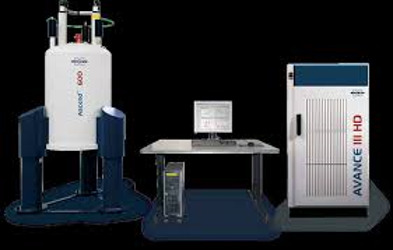
Bruker Avance III 600 MHz NMR spectrometerThe 600 MHz NMR spectrometer at the University of Milano‑Bicocca unit is a Bruker Avance III system designed for high‑resolution structural, dynamic, and compositional analysis of a wide range of chemical, biological, and hybrid materials. Equipped with three interchangeable probes, it supports advanced investigations on liquid solutions, solid‑state samples, and heterogeneous systems, enabling comprehensive studies across multiple research domains. The instrument provides excellent spectral sensitivity and resolution, allowing detailed elucidation of molecular structure, conformational equilibria, intermolecular interactions, and dynamic processes over a broad range of timescales.
For liquid‑state NMR, the system enables routine and multidimensional experiments, including homo‑ and heteronuclear correlation techniques, diffusion‑ordered spectroscopy, and quantitative analyses.
Solid‑state capabilities include magic‑angle spinning, cross‑polarization, and advanced decoupling schemes, making it suitable for crystalline, amorphous, polymeric, and composite materials.
The spectrometer’s architecture supports a wide selection of pulse sequences for multinuclear detection, enabling studies involving nuclei such as ¹H, ¹³C, ¹⁵N, ³¹P, and various quadrupolar species. Automated tuning, matching, and gradient‑assisted experiments ensure high reproducibility and efficient workflow management. Integrated temperature‑control systems allow measurements under variable thermal conditions, facilitating the investigation of thermally activated processes and stability profiles. Overall, the 600 MHz NMR platform provides a robust and versatile solution for academic and industrial research requiring precise molecular‑level characterization.
Technical description
The 600 MHz NMR spectrometer at the University of Milano‑Bicocca unit is a Bruker Avance III system designed for high‑sensitivity structural and dynamic studies on a broad range of chemical and biological samples.
Its configuration includes a QCI cryo‑probe for liquid‑state NMR, optimized for multinuclear detection (¹H, ¹³C, ¹⁵N, ³¹P) and ideal for low‑concentration analytes, biomacromolecules, and unstable or aggregation‑prone systems. The cryogenic technology significantly enhances signal‑to‑noise ratio, enabling rapid acquisition of multidimensional spectra and detailed characterization of molecular interactions, conformational equilibria and kinetic processes. The instrument supports an extensive library of pulse sequences for structural elucidation, quantitative analysis, diffusion measurements, and heteronuclear correlation experiments. Additional probes allow the investigation of solid and heterogeneous samples, extending the system’s applicability to polymers, catalysts, composite materials, and hybrid organic–inorganic systems. Gradient‑assisted experiments, automated tuning and matching, and precise temperature control ensure reproducible measurements across a wide thermal range, facilitating studies of thermally activated processes and stability profiles.
Overall, the 600 MHz NMR platform provides a versatile and high‑performance solution for academic and industrial research requiring advanced molecular‑level insight.Research areas and applications
Chemical areas, pharma areas (including nutraceuticals and cosmetics) – materials area (including crystalline materials and polymers)
Science highlights
Experimental team

- Cristina Airoldi
- University of Milano Bicocca
- Professor

- Claudio Greco
- University of Milano Bicocca
- Professor