How STMicroelectronics and ISIS@MACH Italia Are Reinforcing Electronics for a New Era
An unseen radiation threat is driving new collaborations to protect the electronics behind electrification
Cosmic radiation might seem like a problem for satellites, but it increasingly affects the electronics we depend on every day. For Francesco Pintacuda, Radiation-Hardened Design Manager at STMicroelectronics, understanding how cosmic-ray–generated neutrons interact with modern semiconductor devices is now essential for the future of electric mobility, renewable energy systems and even emerging electric aircraft.
When cosmic rays strike the atmosphere, they create showers of energetic particles — including neutrons — that reach the Earth’s surface. These neutrons can flip bits in memory, corrupt data or trigger sudden “burnout” in power devices. As the world moves toward large-scale electrification, the number of sensitive devices in cars, charging systems, industry and computing infrastructure is rising dramatically, making these rare events more important to understand.
Electronic and power devices sit at the heart of this challenge. These devices convert and control high voltages and currents in electric vehicles, renewable technologies, industrial motors and home appliances. New materials such as silicon carbide (SiC) and gallium nitride (GaN) are transforming this field, offering higher efficiency and longer driving range. Yet they also introduce new, not-yet-fully-understood failure mechanisms, especially under neutron exposure. To build reliable next-generation systems, engineers must understand how these materials behave under the conditions they will face throughout their lifetime.
This is where the suit of Medium Range Facility of ISIS@MACH ITALIA and ChipIR the Neutron beamline at the ISIS Neutron and Muon Source, UK play a crucial role.
ISIS@MACH ITALIA plays a central role in enabling these tests by providing access to its suite of Medium Range Facilities (MRF) for the characterization of electronic and power devices. In addition to state-of-the-art infrastructure, it offers expert support throughout the entire experimental process, from planning and setup optimization to real-time problem solving. The close collaboration between scientists and industrial engineers ensures that each experiment delivers meaningful and actionable results.
The partnership also extends to advanced failure analysis techniques. Traditionally, internal failure analysis required removing a device from its packaging — a laborious process that could itself cause damage. Through ISIS@MACH ITALIA, STMicroelectronics can now analyse devices in their packaged form, leveraging the complementary multilevel techniques available within the MRF suite, including MONeutron, profilometry, and scanning electron microscopy (SEM). By integrating results from these methods, this study enabled, for example, a comprehensive characterization of neutron-induced single-event burnout (SEB), revealing both the 2D and 3D morphology of SEB in silicon carbide (SiC) power MOSFETs [1].
For STMicroelectronics, the collaboration with ISIS@MACH ITALIA and ISIS Neutron and Muon Source is not just scientific — it is strategic. Together, they are improving the reliability of power devices, deepening the understanding of failure mechanisms, informing customer mission profiles and helping shape the standards that will guide the future of electric mobility and aviation.
As Pintacuda puts it: “Working alone, it’s difficult to choose the right methodology. Working together, we can identify the best approach to improve our knowledge and solve real industrial problems and have a crucial impact on society.”
In a world moving rapidly toward electrification, neutron science is emerging as a quiet but powerful ally — ensuring that electric cars, renewable technologies and the aircraft of the future can operate safely in an environment shaped by cosmic radiation.
Further information:
The full paper is available to read here: “Multi-technique characterisations of single event burnout (SEB) in silicon carbide (SiC) power MOSFETs”
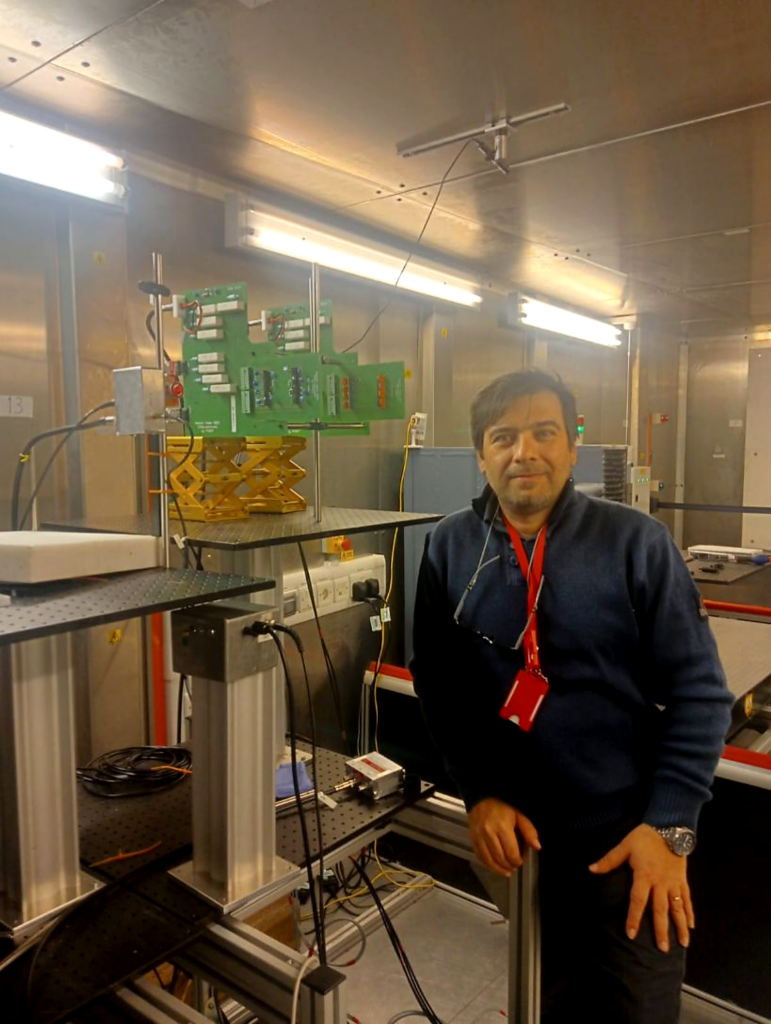
Francesco Pintacuda is a Radiation-Hardened Design Manager at STMicroelectronics, specializing in power discrete transistors for space, avionics, and automotive applications. He has extensive expertise in radiation effects on silicon and SiC devices, including neutron, ion, and X-ray interactions. He collaborates with academic and industrial partners on advanced reliability and next-generation power electronics, and has authored multiple technical publications.