Non-invasive Neutron Techniques for Cultural Heritage used at the Museo Egizio
Access to neutron science is transforming the study and preservation of fragile cultural heritage materials

Studying and preserving ancient artefacts made from organic materials is far from straightforward. Objects such as ancient leather, textiles or human remains are often extremely fragile and can easily be damaged by light, humidity or handling. Over centuries, their internal structure slowly changes, but understanding how and why this happens is difficult — especially when the objects are unique and cannot be sampled or altered.
At the Museo Egizio in Turin, researchers and conservators are tackling this challenge by combining expertise from heritage conservation with advanced scientific methods, supported by ISIS@MACH ITALIA. Their aim is to better understand what is happening inside these ancient objects, so they can make informed decisions about how best to preserve them for the future.
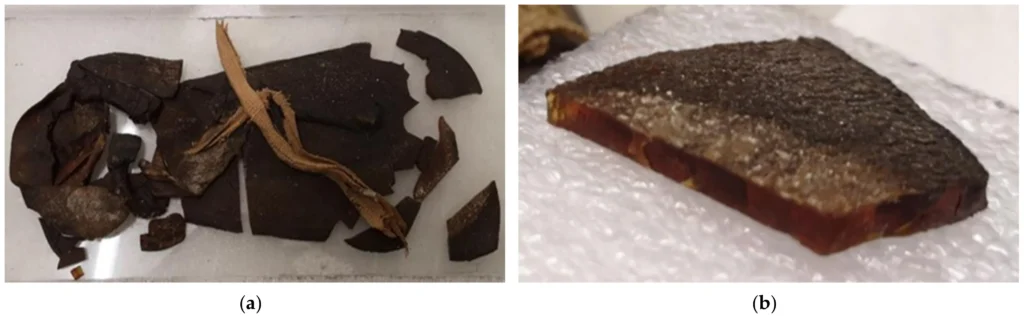
The research focuses on organic materials, which are largely made up of light elements such as hydrogen. Hydrogen plays a key role in materials like collagen, the main component of ancient leather, and changes in its distribution can reveal early signs of degradation. However, many traditional analysis techniques either look only at the surface or require taking samples — something that is often not possible with precious museum artefacts.
As senior conservator Valentina Turina explains,
“The main challenge is studying extremely fragile and often degraded organic materials, whose internal structure is difficult to characterise using conventional techniques.”
This is why non-invasive techniques are essential.
Through the ISIS@MACH ITALIA access programme, the research team was able to apply for and gain access to advanced facilities that are not available in a museum setting. Using neutron-based techniques — alongside X-ray fluorescence and Raman spectroscopy — they were able to examine ancient leather artefacts without any invasive preparation. Neutrons are particularly well suited to this task because they are highly sensitive to hydrogen and can penetrate deep into materials, revealing information about internal composition and moisture that cannot be seen from the surface.
As Valentina notes, “Neutron-based techniques allow us to analyse organic materials in a completely non-invasive way, with high sensitivity to internal features, without altering or damaging historical objects.”
This combined approach allowed the team to study hydration levels, chemical composition and degradation processes in much greater detail than would otherwise be possible. In particular, it revealed internal variations that help explain how and why certain materials deteriorate over time. These insights are crucial for developing better, evidence-based conservation strategies.
Access to IM@IT facilities significantly expanded the range of tools available to the museum, enabling more complete and reliable analyses than could be carried out in-house. Just as importantly, ISIS@MACH ITALIA provides support well beyond access to instruments. Its scientists and technical experts work closely with users throughout the process — from planning experiments to interpreting results — helping to translate complex data into information that is meaningful for conservators and historians.
Reflecting on this collaboration, Valentina Turina highlights that
“Collaboration with IM@IT goes beyond access to instrumentation and includes direct support from scientists and technical experts, helping us turn scientific data into meaningful information for conservation and historical interpretation.”
This collaboration also encourages wider exchange of knowledge, bringing together experts from different disciplines and countries. It supports training and skill development, particularly for early-career conservators and researchers, by exposing them to advanced techniques and international research environments.
Looking to the future, wider use of neutron and muon techniques in cultural heritage research — supported by training and accessible infrastructure — could further strengthen conservation science in Italy. Overall, the work at the Museo Egizio shows how ISIS@MACH ITALIA enables non-invasive research that would otherwise not be possible, helping museums better understand, preserve and interpret fragile artefacts, while demonstrating the real-world impact of large-scale research infrastructure beyond traditional scientific fields.
Further information:
The full paper is available to read here: Non-invasive Neutron Techniques for Cultural Heritage used at the Museo Egizio
Giovanni Romanelli is an experimental physicist in applied physics and condensed-matter physics, with a background in theoretical and experimental nuclear physics. Research interests include the study of the single-particle dynamics and nuclear quantum effects in disordered and hydrogen-bonded systems; the measurement of neutron cross sections with applications to medical physics, radiation protection and engineering; the adsorption and the catalysis of molecular hydrogen in porous materials; the characterization of the resilience and radiation hardening of electronic devices in mixed radiation fields.

Valentina Turina graduated in Conservation and Restoration of Cultural Heritage from the University of Turin, specialising in textile and leather artefacts. Since 2014 she has worked at the Museo Egizio in Turin, initially in the Registrar’s Office and, since 2019, in the Conservation and Diagnostics Department. Her work focuses on the management and conservation of the museum’s textile and anthropological collections, as well as coordinating diagnostic investigations. She has also participated in the joint archaeological mission of the Museo Egizio and the Rijksmuseum of Leiden at Saqqara, studying archaeological textile materials.