
AFM
General Information
Technique
Key Instrumentation
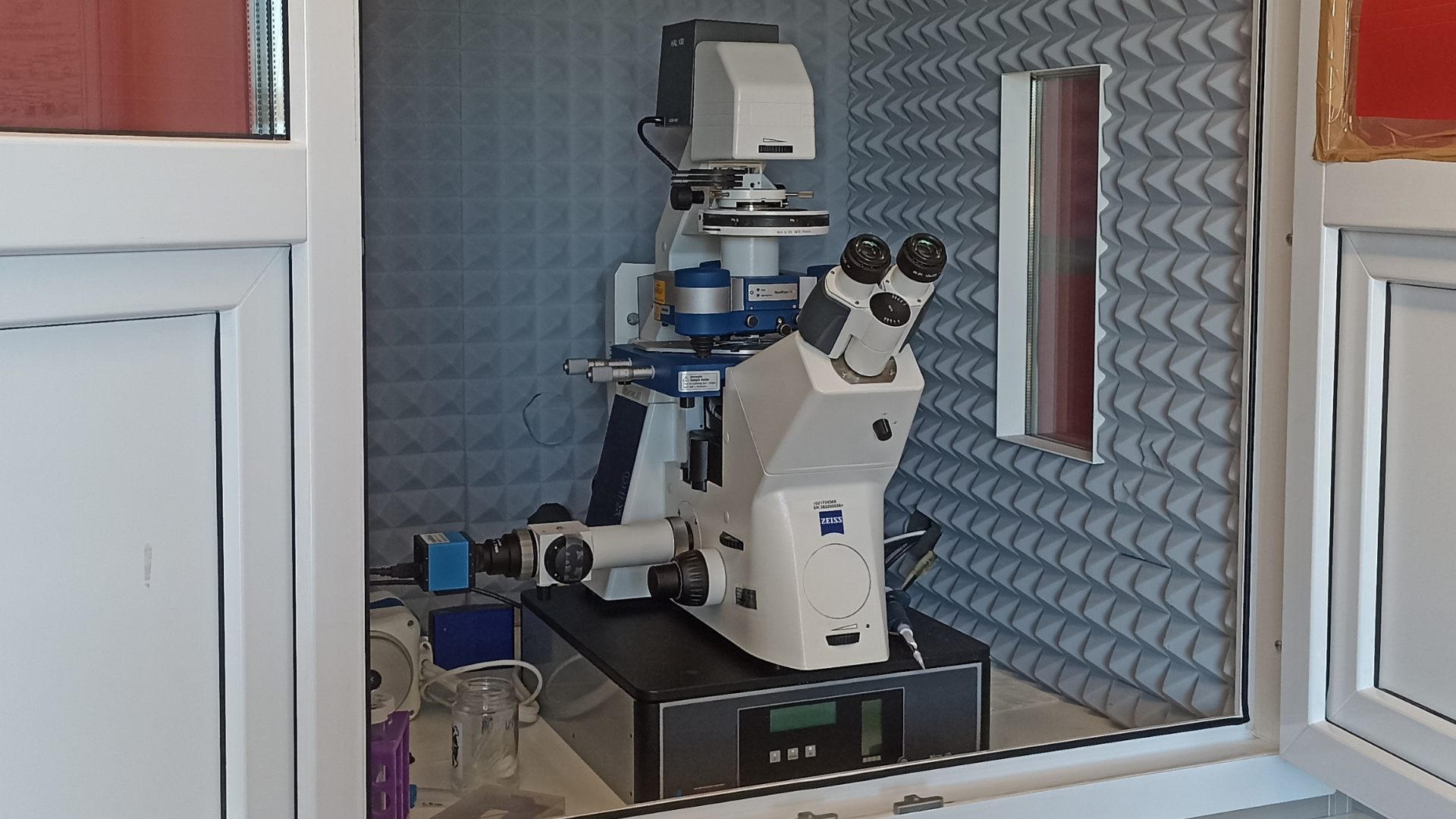
AFM Nanowizard 4XP - JPK-BrukerThe Nanowizard® 4XP – JPK-Bruker Atomic Force Microscope integrates high spatial resolution, force sensitivity, and rapid scanning performance in a single, versatile platform. With scan rates of up to 150 lines/sec and a large 100 µm scan range, this AFM system enables high-resolution topographical imaging together with precise quantitative mechanical measurements across a wide variety of sample types. It is specifically engineered to provide exceptional mechanical and thermal stability when mounted on inverted optical microscopes, ensuring reliable performance during long-term experiments. This makes it suitable for investigations ranging from single molecules and macromolecular assemblies to living cells and tissue samples under physiologically relevant conditions. The system supports structural analysis, nanomechanical characterization, and biophysical investigations of complex biological systems, allowing researchers to probe fundamental molecular mechanisms, biochemical interactions, and cellular mechanics at the nanoscale. Its flexibility and performance make it ideal for applications in cell biology, biophysics, biomaterials science, and mechanobiology. In addition, it is equipped with the JPK CellMech Package, specifically developed for advanced microrheology measurements, enabling quantitative assessment of viscoelastic properties, force-dependent behaviors, and intracellular mechanical responses of biological samples under controlled experimental conditions. Data analysis is supported by the JPK DP software, which facilitates efficient visualization, processing, and quantitative interpretation of AFM imaging, force spectroscopy, and microrheology data.
Technical description
The NanoWizard 4XP AFM (JPK-Bruker) is optimized for advanced research on soft materials, including live cells, cell membranes, hydrogels, and biomaterials, as well as for force spectroscopy studies such as ligand–receptor interactions, protein unfolding, and cell adhesion. It provides high-resolution topographical imaging combined with accurate quantitative force measurements in both air and liquid environments, enabling experiments under physiologically relevant conditions.
The system is seamlessly coupled to a Zeiss inverted optical microscope equipped with a Colibri illumination source for wide spectral fluorescence excitation (365 nm, 470 nm, 590 nm), allowing fully correlated AFM and fluorescence observations. The patented DirectOverlay™ software enables distortion-free integration of AFM and optical images, ensuring precise spatial correlation between nanomechanical data and optical features. Featuring a large 100 × 100 µm² scan area and a 15 µm Z-range, the microscope guarantees high performance, accuracy, and reproducibility through closed-loop operation with capacitive sensors. The integrated JPK CellMech Package further extends the platform capabilities to advanced microrheology, enabling quantitative measurement of frequency-dependent mechanical responses and viscoelastic moduli of cells and soft matter up to 500 Hz for comprehensive biomechanical characterization.Research areas and applications
The Nanowizard 4XP supports a broad range of cutting-edge research applications in the fields of biophysics, mechanobiology, and nanomedicine. It enables detailed morphological characterization of single DNA filaments, macromolecular assemblies, and cellular ultrastructure with nanometer resolution. The system is widely used for nanomechanical profiling of single cells, cell membranes, extracellular matrices, and soft biological materials, allowing quantitative mapping of mechanical heterogeneity at the nanoscale. Advanced force spectroscopy capabilities support studies of protein unfolding, ligand–receptor interactions, and cell mechanics, providing insight into molecular binding forces and interaction dynamics. The integrated microrheology functionalities allow quantitative analysis of viscoelastic properties of cells and soft matter, offering access to frequency-dependent mechanical responses, cytoskeletal organization, and cellular adaptation to mechanical stimuli. In addition, the platform supports correlative AFM–optical experiments, enabling direct linkage between nanomechanical properties and dynamic cellular processes observed by fluorescence microscopy. Together, these applications are essential for advancing research on cell mechanics, biomaterials, disease-related mechanical alterations, and mechanotransduction processes in health and pathological conditions.
Science highlights
L. Pellegrino, G. Savorana, V. Cassina, R. Campanile, M. Centola, C. Belgiovine, V. Vinci, M. Klinger, S. Lecuyer, E. D’Imprima, F. Mantegazza, E. Secchi, R. Rusconi. Nat. Commun. 17, 1324 (2026). https://doi.org/10.1038/s41467-025-68078-5
M. Piazzoni, I. Borghi, F. Cadamuro, S. Dalfino, R. Campanile, S. Nizzolo, V. Cassina, F. Tallia, J. R. Jones, F. Mantegazza, S. Bertini, L. Moroni, F. Nicotra, L. Russo. Adv. Funct. Mater. (2025). https://doi.org/10.1002/adfm.202519933
M. Sampietro, V. Cassina, D. Salerno, F. Barbaglio, E. Buglione, C. A. Marrano, R. Campanile, L. Scarfò, D. Biedenweg, B. Fregin, M. Zamai, A. Díaz Torres, V. Labrador Cantarero, P. Ghia, O. Otto, F. Mantegazza, V. R. Caiolfa, C. Scielzo. HemaSphere. 7, e931 (2023). https://doi.org/10.1097/HS9.0000000000000931
Experimental team

- Valeria Cassina
- University of Milano Bicocca
- Instrument Scientist

- Francesco Mantegazza
- University of Milano Bicocca

- Riccardo Campanile
- University of Milano Bicocca
- PhD Student

- Domenico Salerno
- University of Milano Bicocca
- Researcher