
XRD TOMOGRAPHY
General Information
Unit
CNR-IPCBTechnique
Key Instrumentation
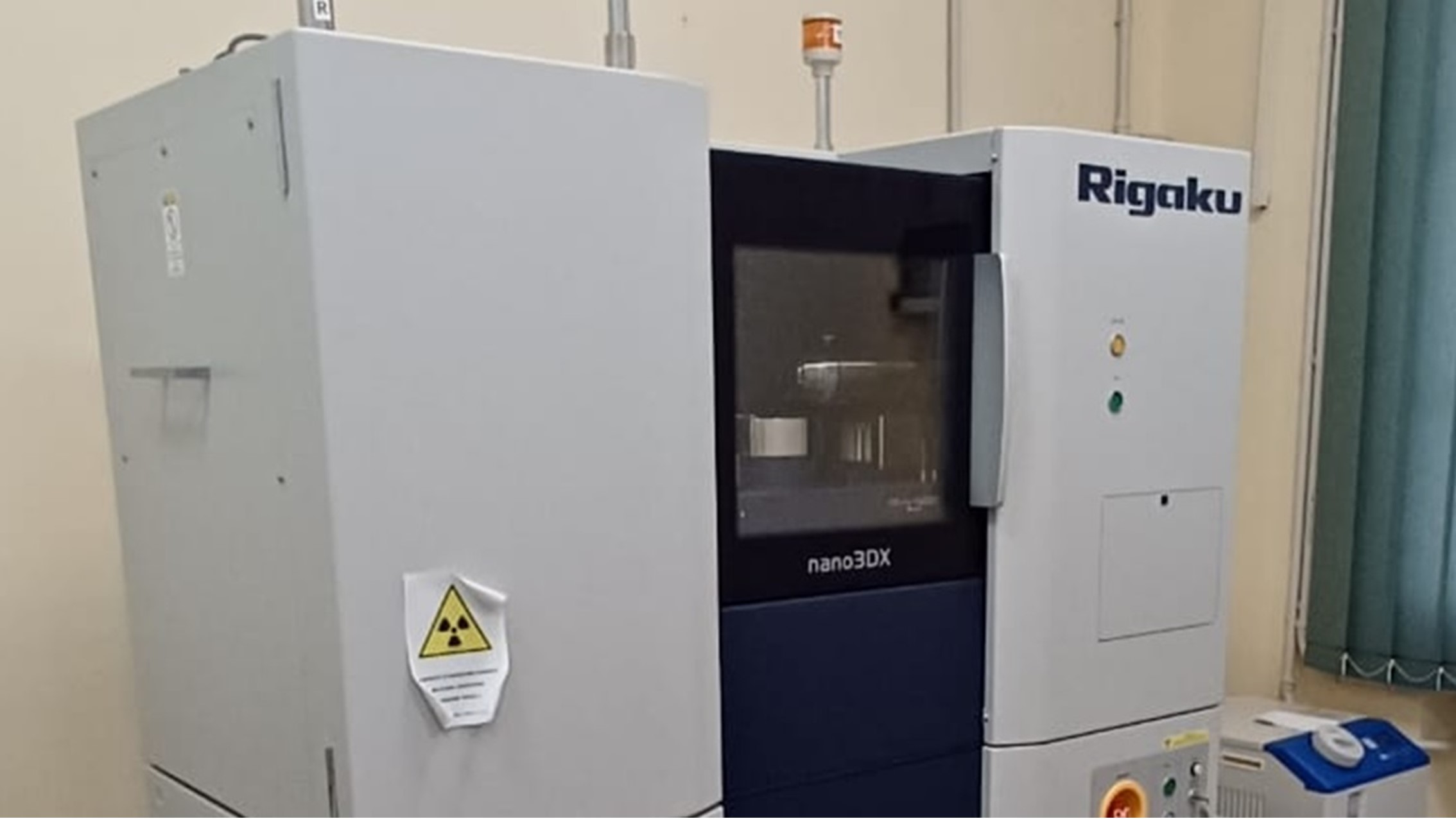
The RIGAKU Nano3DX is a X-ray microscope to measure large samples at high resolution.The Rigaku Nano3DX system at the CNR‑IPCB unit is a high‑resolution X‑ray diffraction tomography instrument designed for non‑destructive 3D structural characterization of inorganic, organic, and biological materials. It combines submicron spatial resolution with diffraction‑based phase sensitivity, enabling simultaneous visualization of internal morphology and crystallographic information. The system is built around a 1 kW continuous rotating‑anode X‑ray generator equipped with dual anodes (Cr/Mo or alternative combinations), providing high analytical versatility and stable high‑flux illumination. The source features an 80 µm spot size to minimize drift during long acquisitions. Detection is performed using a high‑resolution sCMOS camera with 2048 × 2048 pixels, 6.5 µm pixel size, 16‑bit dynamic range, and interchangeable optics that allow effective pixel sizes from 0.325 µm to 5.2 µm. Two dedicated lenses provide fields of view of 10.64 mm and 2.66 mm, supporting both wide‑area scans and high‑resolution tomography with spatial resolution below 500 nm. The system employs near‑parallel beam geometry to reduce projection distortions and improve reconstruction fidelity. Samples up to 20 mm in diameter and 40 mm in height can be mounted on an automated sample holder for precise, reproducible positioning. A dedicated environmental module enables temperature‑controlled experiments from room temperature to 200 °C and mechanical compression from 1 to 200 N on specimens up to 10 mm in diameter and 2 mm thick. This combination of high‑flux X‑ray generation, flexible detection optics, environmental control, and mechanical loading makes the Nano3DX a powerful tool for studying structural evolution, phase transformations, and deformation mechanisms in complex materials.
Technical description
The X‑ray Diffraction Tomography system at the CNR‑IPCB unit is a high‑performance platform designed for non‑destructive structural analysis of heterogeneous materials, enabling simultaneous 3D imaging and diffraction‑based phase identification. The instrument is built around a 1 kW continuous rotating‑anode X‑ray generator equipped with a dual‑anode configuration (Cr/Mo or alternative combinations), providing high analytical versatility and stable beam output. The source features an 80 µm spot size to minimize drift and ensure consistent illumination during long acquisitions. Detection is performed using a high‑resolution sCMOS camera with 2048 × 2048 pixels, 6.5 µm pixel size, 16‑bit dynamic range, and interchangeable optics enabling effective pixel sizes from 0.325 µm to 5.2 µm. Two dedicated lenses allow fields of view of 10.64 mm or 2.66 mm, supporting both wide‑area scans and high‑resolution tomography with spatial resolution below 500 nm. The system employs near‑parallel beam geometry to reduce projection distortions and enhance reconstruction fidelity. Samples up to 20 mm in diameter and 40 mm in height can be mounted on an automated sample holder for precise, reproducible positioning. A dedicated environmental module enables temperature‑controlled experiments from room temperature to 200 °C and mechanical compression from 1 to 200 N on specimens up to 10 mm in diameter and 2 mm thick.
Research areas and applications
The RIGAKU Nano3DX is a submicron resolution computed tomography scanner useful for the structural characterization, including3D reconstruction with high resolution, of inorganic, organic and biological materials.
Science highlights
Experimental team

- Marino Lavorgna
- CNR-IPCB
- Researcher