ESCALAB QXi
General Information
Unit
CNR-ICMATETechnique
Key Instrumentation
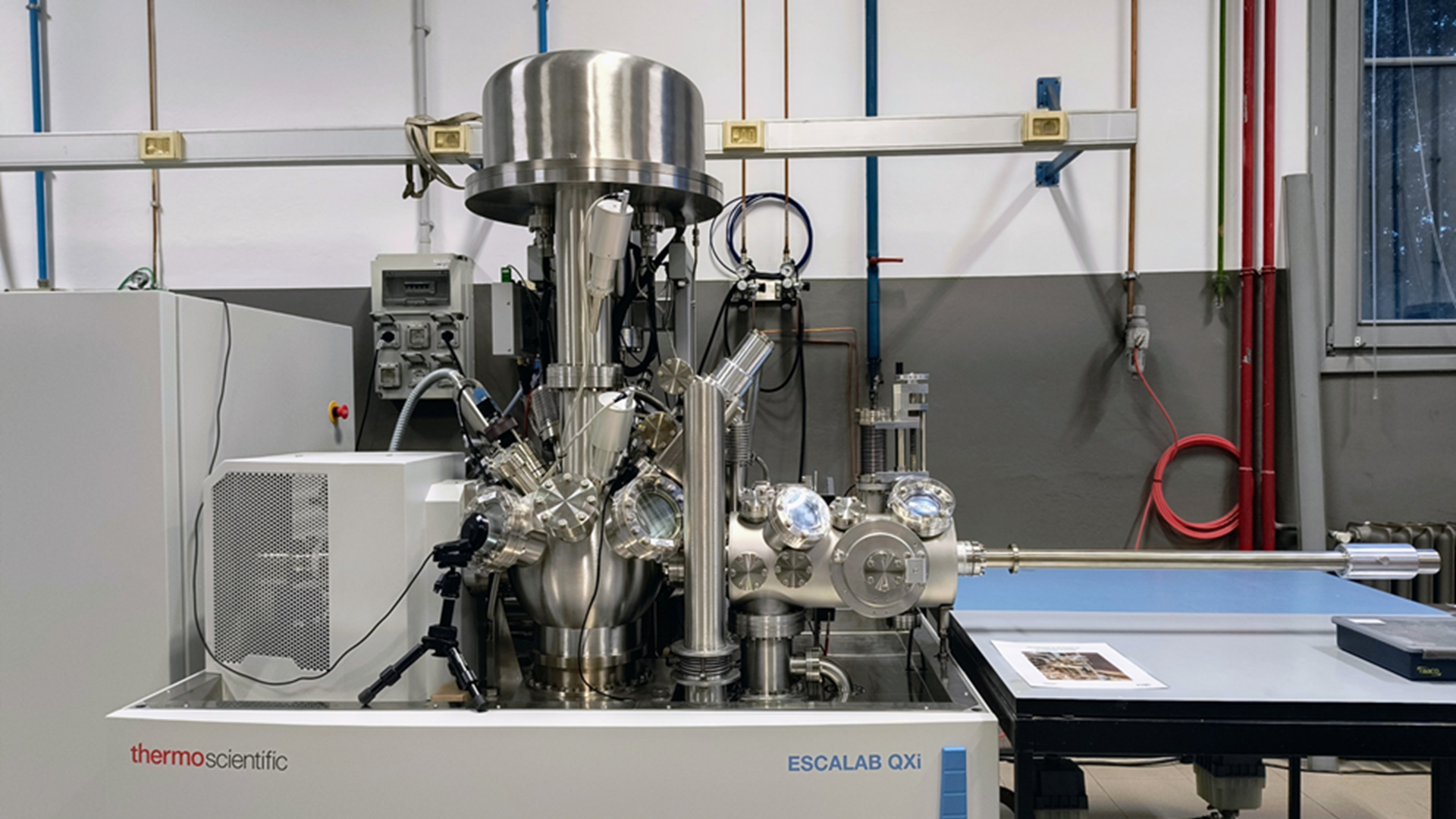
The ESCALAB QXi X-ray photoelectron spectrometer is a versatile, multi-technique analytical platform designed for advanced surface and interface characterization. It supports a wide range of spectroscopic methods, including XPS, UPS, REELS, and ISS, enabling both chemical and electronic structure investigations with high surface sensitivity. The system is equipped with a dual-mode ion gun operating in both monoatomic and cluster configurations, allowing efficient surface cleaning, depth profiling, and controlled sputtering of delicate materials such as polymers, organic thin films, and hybrid interfaces, while minimizing damage and preferential sputtering effects. To ensure reliable analysis of non-conductive and insulating samples, the instrument integrates an advanced charge compensation system, which stabilizes surface potential during measurements and improves peak resolution and binding energy accuracy. The ESCALAB QXi is also equipped with two complementary detector systems to optimize performance across different acquisition modes. A spectroscopy-optimized detector, based on an array of six-channel electron multipliers, ensures high sensitivity and fast data collection for quantitative and high-resolution measurements. In parallel, an imaging detector system composed of a pair of channel plates coupled with a continuous position-sensitive detector enables rapid parallel imaging and spatially resolved analysis, supporting chemical mapping and the investigation of heterogeneous surfaces.
This combination makes the ESCALAB QXi an ideal tool for both routine characterization and advanced, state-of-the-art research in materials science.
Technical description
ESCALAB QXi X-ray photoelectron spectrometer is a multitechnique-platform for XPS, UPS, REELS and ISS spectroscopies equipped also with a dual mode ion gun for depth profile analysis.
XPS (X-ray photoelectron spectroscopy) provides the composition of the outer few nanometers of a material detailing and quantifying both the elements present and their chemical states. The main XPS features are:
– monochromatic Al/Ag source for large and small area XPS (mm2 – μm2)
– Al/Mg twin source non monochromatic
– magnetic lens
– flood gun for charge compensation
– ARXPS (angle resolved XPS)
UPS (ultraviolet photoelectron spectroscopy) gives information on the valence band and it allows to determine the electronic work function, valence band maximum and ionization potential.
REELS (reflected electron energy loss spectroscopy) is a technique used to probe the electronic structure of the material at the surface (band gap, if > 2.5 eV). In some cases, it is also able to detect hydrogen, which is not possible with XPS.
ISS (ion scattering spectroscopy) is a highly surface-sensitive technique used to probe the elemental composition of the first atomic layer of a surface.
DUAL MODE ION GUN enables depth profiling of soft materials such as polymers and organic materials using gas cluster ions as well as of hard materials (metals and inorganics) using monatomic ions.Research areas and applications
Photoelectron Spectroscopies (XPS and UPS) are key surface-sensitive techniques widely used in both applied research and industrial development. XPS provides elemental composition and chemical state information, enabling the identification of oxidation states, bonding environments, and surface contamination. It is extensively applied in materials science, catalysis, corrosion studies, semiconductor processing, and thin-film engineering. In microelectronics, XPS supports process control by monitoring interface chemistry, dopant diffusion, and dielectric layer quality. In energy-related research, it is crucial for studying battery electrodes, solid electrolytes, and degradation mechanisms in photovoltaic devices. UPS complements XPS by probing the valence band structure and electronic states close to the Fermi level. It is particularly valuable for investigating work function, ionization energy, and charge transfer processes. UPS is a central tool in the development of both inorganic and organic electronics, such as OLEDs, organic photovoltaics, hybrid perovskite-based devices and inorganic solar cells where energy level alignment at interfaces governs performance.
Together, XPS and UPS play a strategic role in advancing surface and interface science and materials across catalysis, semiconductors, energy, biomaterials, coatings, corrosion science and nanotechnology.
Science highlights
Parnigotto, G. Dal Sasso, M. Mazzucato, M. C. Dalconi, D. Badocco, E. Menna, P. Pastore, M. Rancan, L. Armelao, C. Durante, Nanoscale (2026) <a href=”https://doi.org/10.1039/D5NR04642D”>https://doi.org/10.1039/D5NR04642D</a>
Butrichi, V. Trifiletti, G. Tseberlidis, B. E. G. Colombo, F. Taglietti, M. Rancan, L. Armelao, S. Binetti, Solar Energy Materials and Solar Cells, 272, 112924 (2024) <a href=”https://doi.org/10.1016/j.solmat.2024.112924″>https://doi.org/10.1016/j.solmat.2024.112924</a>
Mantovani, A. Pintus, A. Kovtun, A. Gondolini, S. Casadio, A. Sanson, T. D. Marforio, M. Calvaresi, M. Rancan, L. Armelao, G. Bertuzzi, M. Melucci, M. Bandini ChemSusChem, 17, e202301673 (2024)<a href=”https://doi.org/10.1002/cssc.202301673″> https://doi.org/10.1002/cssc.202301673</a>