
FT-IR Nexus
General Information
Technique
Key Instrumentation
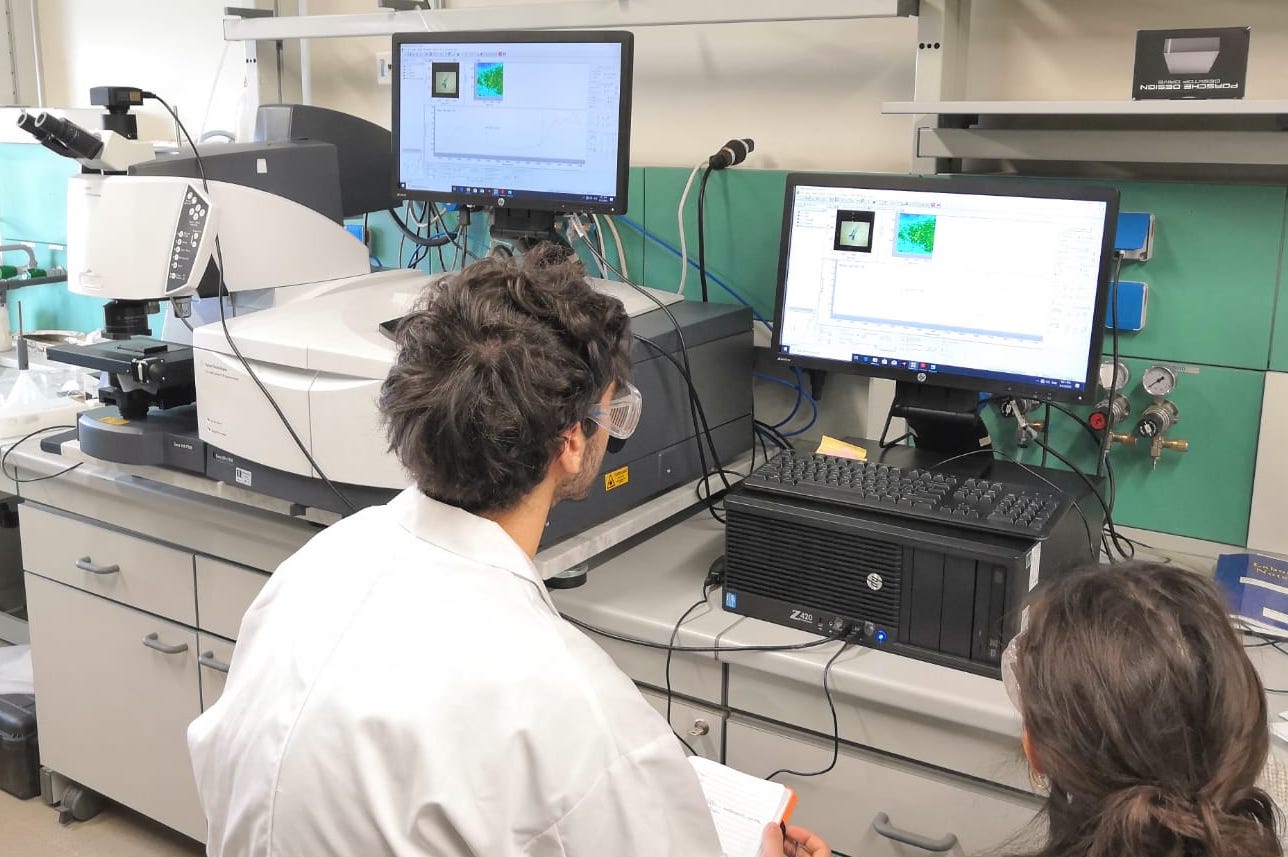
FT-IR and FT-IR MicroscopyThe Nicolet Nexus 870 FT‑IR system at the CSGI unit of the University of Florence is a versatile platform designed for high‑quality infrared spectroscopy and infrared microscopy, enabling detailed chemical characterization of organic, inorganic and hybrid materials. The instrument supports mid‑IR spectral acquisition with excellent signal‑to‑noise performance, making it suitable for routine analysis as well as advanced research applications requiring high spectral fidelity. Its modular architecture allows the integration of multiple sampling accessories, including transmission cells, ATR crystals, diffuse and specular reflectance modules, and environmental chambers for controlled‑atmosphere measurements. The microscope unit enables spatially resolved FT‑IR imaging and micro‑spectroscopy, allowing users to investigate heterogeneous samples, map chemical distributions and analyze micro‑domains, inclusions, thin films and surface contaminants with micrometric precision. Automated stage control and interchangeable objectives support both point‑by‑point analysis and hyperspectral mapping. The system’s optical design ensures stable interferometric performance, while advanced software tools provide robust baseline correction, spectral deconvolution, library matching and quantitative analysis. Typical applications include polymer characterization, surface chemistry, cultural‑heritage studies, environmental analysis, pharmaceuticals and soft‑matter research. The Nexus 870 offers researchers and industrial partners a reliable, flexible and high‑performance solution for comprehensive molecular identification and structural investigation across a wide range of materials.
Technical description
The Nicolet Nexus 870 at the CSGI unit of the University of Florence is a high performance FT IR spectroscopy and microscopy system designed for detailed molecular characterization of heterogeneous materials. The instrument is mounted on an external optical table for enhanced mechanical stability and is equipped with two external detectors—MCT and TRS—to ensure high sensitivity across the mid IR range. A Ge ATR accessory enables surface specific analysis of thin films, coatings and micro samples, while a Hind photoelastic modulator supports polarization modulated measurements for studies of molecular orientation and anisotropy. The integrated IR Continuum microscope allows simultaneous FT IR spectral acquisition and imaging, enabling chemical mapping of micrometric particles, inclusions, domains and powders with high spatial resolution. Automated stage control and interchangeable objectives support both point analysis and hyperspectral imaging workflows. The system’s configuration allows users to analyze flat samples, particulates and complex microstructures without compromising spectral quality. Advanced software tools provide robust baseline correction, spectral deconvolution and library matching, making the Nexus 870 a versatile platform for applications in materials science, cultural heritage, environmental analysis, pharmaceuticals and soft matter research.
Research areas and applications
FTIR (Fourier transform infrared spectroscopy) is a fast, easy and reliable technique for material identification and quantification of constituents in a sample. The combination with optical microscopy allows for the chemical mapping of complex systems and interfaces, such as mixtures, surface coatings, films, pharmaceuticals, etc.
Science highlights
- Nanotechnologies for Conservation of Cultural Heritage: Paper and Canvas Deacidification, Giorgi et al, https://doi.org/10.1021/la025964d
- Innovative Hydrogels Based on Semi-Interpenetrating p(HEMA)/PVP Networks for the Cleaning of Water-Sensitive Cultural Heritage Artifacts, Domingues et al. https://doi.org/10.1021/la3048664
- Adsorption of Amino Acids and Glutamic Acid-Based Surfactants on Imogolite Clays, Bonini et al. https://doi.org/10.1021/acs.langmuir.6b04414
Experimental team

- Emiliano Fratini
- CSGI-University of Florence
- Professor