
AFM Raman with Optical Profiler
General Information
Technique
Key Instrumentation
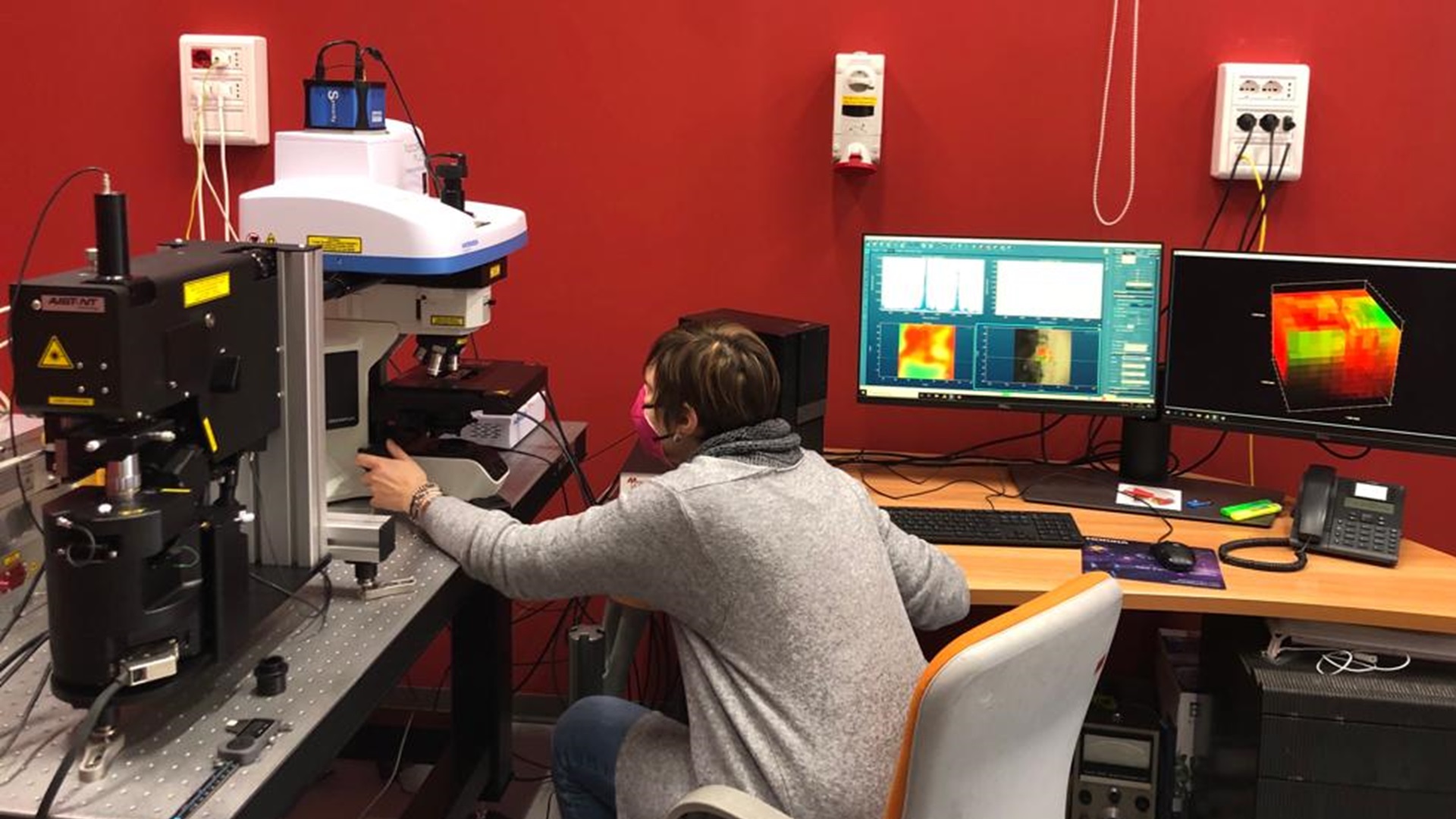
The Atomic Force Microscope‑Raman platform at the NAST Centre, University of Rome Tor Vergata, integrates a fully automated XploRA Plus micro‑Raman spectrometer with an advanced atomic force microscope to enable combined Raman‑AFM and TERS (Tip-Enhanced Raman Spectroscopy) analyses on a wide range of materials and devices. The system supports confocal Raman, fluorescence and photoluminescence imaging, allowing users to acquire chemical, structural and optical information with diffraction‑limited resolution. Through external manipulators and specialized probes, it provides flexible access to micro and nanoscale regions of interest, enabling correlative studies that link vibrational signatures with topographical, mechanical and electrical properties. The Atomic Force Microscope module operates in multiple modes, including contact, tapping, phase imaging and force spectroscopy, making it suitable for polymers, nanostructures, thin films, 2D materials and biological samples. Complementing the AFM‑Raman unit, the ZETA Instruments Z20 Optical Profiler offers non‑contact 3D surface metrology and high‑resolution imaging of any type of surface or light‑emitting structure. Its ability to simultaneously collect quantitative 3D data and true‑colour infinite‑focus images provides a valuable bridge between microscale optical inspection and nanoscale AFM‑Raman characterization. Together, these instruments form a versatile, multi‑modal platform that supports advanced research in materials science, nanotechnology, micro‑ and nano‑fabrication, photonics and bio‑interfaces, offering academic and industrial users a powerful toolset for comprehensive, multi‑scale analysis.
Technical description
The AFM‑Raman system at the NAST Centre integrates a high‑performance Raman microscope with an atomic force microscope and an ancillary optical profiler to enable multi‑modal micro- and nanoscale characterization. The Raman unit includes three internal excitation lasers (532 nm, 638 nm and 785 nm), twelve density‑filter levels and four gratings (600 g/mm, 1200 g/mm, 1800 g/mm and 2400 g/mm), providing full UV‑Vis spectral coverage with high resolution. The accessible spectral range spans 75 cm⁻¹–4000 cm⁻¹, supporting detailed vibrational analysis of polymers, 2D materials, nanostructures and biological samples. Measurements can be performed either in standard confocal microscopy mode or in AFM‑coupled mode, directing the laser to two distinct sample positions for correlative Raman‑AFM and TERS investigations. The integrated optical profiler (Z20, ZETA Instruments) offers non‑contact 3D surface metrology with a 100 × 100 mm XY stage, motorized Z‑axis control and magnifications from 5× to 100×, corresponding to fields of view between 20 mm and 1 mm. A 5‑MP CCD camera enables high‑resolution imaging and true‑colour surface reconstruction. Together, the AFM‑Raman system and optical profiler provide a versatile platform for structural, chemical and topographical analysis, supporting advanced research in materials science, micro‑ and nano‑fabrication, photonics and bio‑interfaces.
Research areas and applications
Nanostructured materials characterization; spatial characterizations; 3D Raman imaging; polymers; pharmaceuticals; gem investigation and mineral phases. Characterization of composite materials, solar cells, LAB on Chip, MEMS e MicroFluidica, robotics and microelectronics (3D metrology and in semiconductors).
Science highlights
M. Monsoor Shaik, D. Ami, A. Romerio, C. Gagliano, C. Palmer, Z. Aladailleh, E. Mitchell, J. Lopez Chavez, A. Zain, S. Farris, M. Gaboardi, A. Natalello, G. Pirianov, F. Peri; Representative secondary PET micro and nanoplastics via ethylene glycol fragmentation (EGF): physicochemical and immuno-toxicological properties. Chemical Engineering Journal Advances, 2026, 101053, doi:10.1016/j.ceja.2026.101053.
Experimental team

- ISIS@MACH ITALIA
Laura Conti

- Università di Roma Tor Vergata
- Researcher