
Dynamic Mechanical Analyzer
General Information
Technique
Key Instrumentation
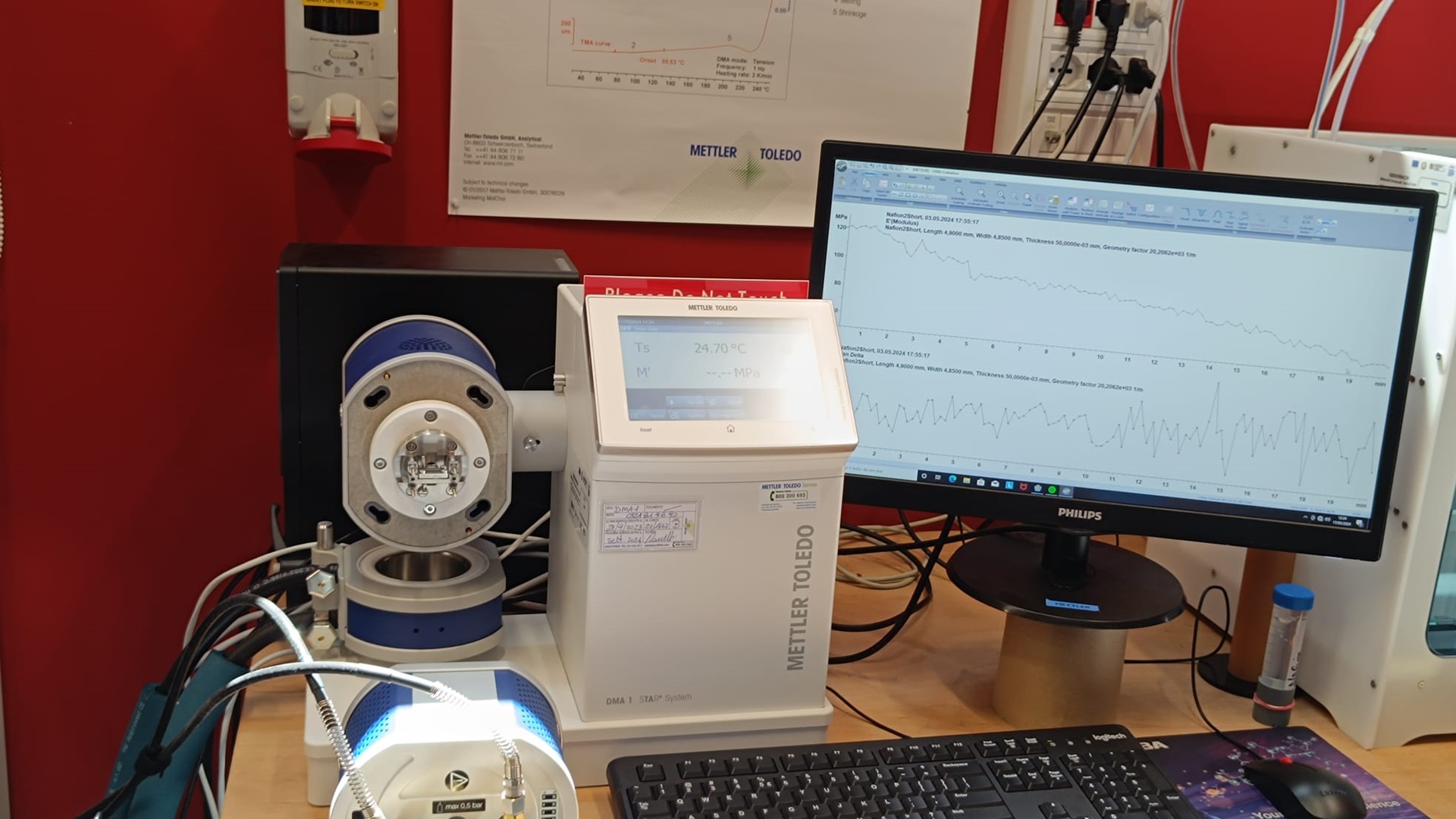
Bio-Chemical-Magnetic CharacterizationThe Dynamic Mechanical Analyzer (DMA) at the NAST Centre, University of Rome Tor Vergata, is a multifunctional platform designed for precise characterization of the viscoelastic and thermomechanical properties of polymers, composites, gels, thin films and advanced functional materials. The instrument supports all conventional deformation modes—bending, tension, shear and compression—allowing users to select the most appropriate configuration for each sample type and mechanical regime. Its measuring head can be flexibly positioned, enabling analyses to be performed not only under standard ambient conditions but also when samples are immersed in liquids or exposed to atmospheres with controlled relative humidity. This versatility makes the system suitable for studying environmental effects, solvent interactions and moisture dependent mechanical behavior. The DMA is engineered for rapid setup, facilitating both traditional dynamic mechanical tests and experiments involving static forces, creep, stress relaxation or immersion protocols. Temperature controlled operation enables the investigation of transitions, softening phenomena and time dependent responses across a wide thermal range. In addition to dynamic mechanical measurements, the instrument provides Thermomechanical Analysis (TMA) capabilities for determining thermal expansion coefficients, dimensional stability and deformation under constant load. Together, these features offer researchers and industrial users a robust, adaptable tool for probing structure–property relationships, optimizing material formulations and evaluating performance under realistic operating conditions.
Technical description
Features and benefits of the METTLER TOLEDO DMA 1 include:
– flexible positioning of the measuring head for measurements in all deformation modes, even in liquids or at different relative humidity levels
– easy operation, allowing fast change of deformation modes
– TMA measurements, for measuring expansion coefficients, effects due to creep, and relaxation times
– humidity option, for sorption and desorption measurements
– ergonomic design with large touchscreen, for convenient sample loading and monitoring of the measurement process
– wide temperature range (from –190 to 600 °C)
– extremely efficient and economical cooling, saves valuable measurement time and reduces liquid nitrogen consumption.Research areas and applications
Thermoplastics, Thermosets, Elastomers, Ceramics, Thermal Energy Storage materials.
Science highlights
Experimental team

- Giovanni Romanelli
- NAST Centre - University of Rome Tor Vergata
- Professor

- Triestino Minniti
- NAST Centre - University of Rome Tor Vergata
- Professor