EcoBiM LAB
General Information
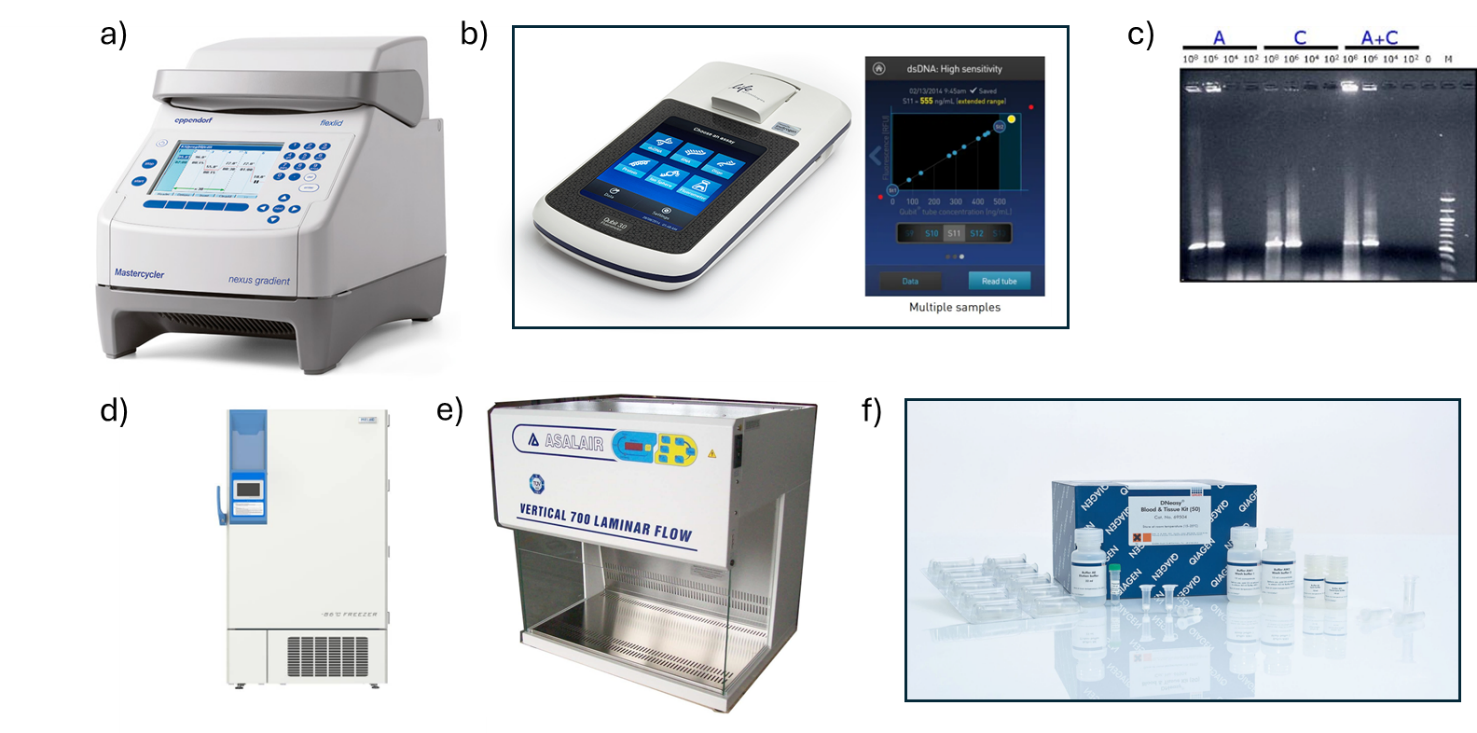
EcoBiM LAB is a molecular facility dedicated to preparing environmental samples for the extraction, quantification, and quality assessment of microbial DNA. The laboratory handles matrices including seawater, sea ice and snow, soils, plant roots, and marine sediments collected from polar and other sensitive regions. Sample pre-treatment workflows are tailored to each matrix to maximize cell recovery while minimizing contamination and DNA degradation. DNA extraction protocols combine commercial kits and in-house-optimized procedures, enabling efficient recovery of nucleic acids from low-biomass or inhibitor-rich samples. Quantification and purity assessment rely on fluorometric measurements with a Qubit fluorometer and agarose gel electrophoresis, supported by controls on amplification performance. The facility is equipped with laminar-flow biosafety cabinets for sterile handling, refrigerated centrifuges, incubators, and shakers for microbial cultivation, and −20 °C/−80 °C freezers for secure storage of samples and extracted DNA. EcoBiM LAB provides standardized workflows that ensure the production of high-quality DNA suitable for a broad spectrum of downstream molecular applications, including amplicon sequencing, metagenomics, and functional gene analyses in collaborative projects.
Technical description
EcoBiM LAB is equipped for standardized extraction and quality control of microbial DNA from a wide range of environmental matrices. Core instrumentation includes laminar-flow biosafety cabinets for sterile sample handling, refrigerated bench-top and high-speed centrifuges for cell concentration and phase separation, and −20 °C/−80 °C freezers for long-term storage of samples and nucleic acids. DNA quantity and integrity are assessed using a Qubit fluorometer with dedicated assays for double-stranded DNA, agarose gel electrophoresis systems for visualization of fragment size and degradation patterns, and thermocyclers for endpoint PCR and method validation. The laboratory is organized in clean and post-PCR areas, enabling contamination-controlled workflows from sample receipt to DNA aliquoting for downstream sequencing and other molecular analyses.
Research areas and applications
EcoBiM LAB underpins research in environmental and polar microbiology by providing high-quality microbial DNA from complex matrices for downstream molecular analyses. Primary application areas include the study of microbial diversity and community structure in seawater, sea ice, snow, soils, plant roots, and sediments from polar and temperate environments, using amplicon sequencing, metagenomics, and functional gene surveys. Standardized extraction and quality control procedures enable comparisons across sites, seasons, and experimental treatments, supporting investigations of how microbial communities respond to gradients in temperature, salinity, pH, nutrient availability, and contaminant loads. The laboratory also supports projects focused on the role of microorganisms in biogeochemical cycles, including carbon and nutrient turnover, and on microbe–host interactions in plant rhizospheres and benthic invertebrates. Special attention is given to low-biomass and inhibitor-rich samples, such as permafrost-affected soils, cryoconite, and contaminated sediments, where optimized extraction protocols and stringent quality checks are essential to avoid bias in downstream analyses. EcoBiM LAB contributes to method development and intercalibration exercises for environmental DNA workflows and provides technical support and training for students and project partners. The facility is open to collaborative projects that integrate field observations, cultivation-based approaches, and omics data to better understand the adaptation, resilience, and ecosystem functions of microbial communities in changing marine and terrestrial environments.
Science highlights
Lo Giudice A., Papale M., Azzaro M., Rizzo C.
Prokaryotic diversity in the sponges Mycale (Oxymycale) acerata (Kirkpatrick, 1907) and Dendrilla
antarctica (Topsent, 1905) from two distant Antarctic marine areas: South Cove at Rothera Point
(Adelaide Island, Western Antarctic Peninsula) and Thetys Bay (Terra Nova Bay, Ross Sea).
Deep Sea Research Part II: Topical Studies in Oceanography, 2024, 216, 105391.
https://doi.org/10.1016/j.dsr2.2024.105391 ResearchGateGuglielmin M., Azzaro M., Buzzini P., Battistel D., Roman M., Ponti S., Turchetti B., Sannino C.,
Borruso L., Papale M., Lo Giudice A.
A possible unique ecosystem in the endoglacial hypersaline brines in Antarctica.
Scientific Reports, 2023, 13, 177. https://doi.org/10.1038/s41598-022-27219-2 Nature+1Azzaro M., Papale M., Rizzo C., Forte E., Lenaz D., Guglielmin M., Lo Giudice A.
Antarctic Salt-Cones: An Oasis of Microbial Life? The Example of Boulder Clay Glacier (Northern
Victoria Land).
Microorganisms, 2022, 10(9), 1753. https://doi.org/10.3390/microorganisms10091753 MDPIPapale M., Rizzo C., Giannarelli S., Caruso G., Amalfitano S., Aspholm P.E., Maimone G.,
Miserocchi S., Rappazzo A.C., Lo Giudice A., Azzaro M.Benthic Microbial Communities in a Seasonally Ice-Covered Sub-Arctic River (Pasvik River, Norway)
Are Shaped by Site-Specific Environmental Conditions.
Microorganisms, 2022, 10(5), 1022. https://doi.org/10.3390/microorganisms10051022