
FTIR-ATR Nicolet
General Information
Technique
Key Instrumentation
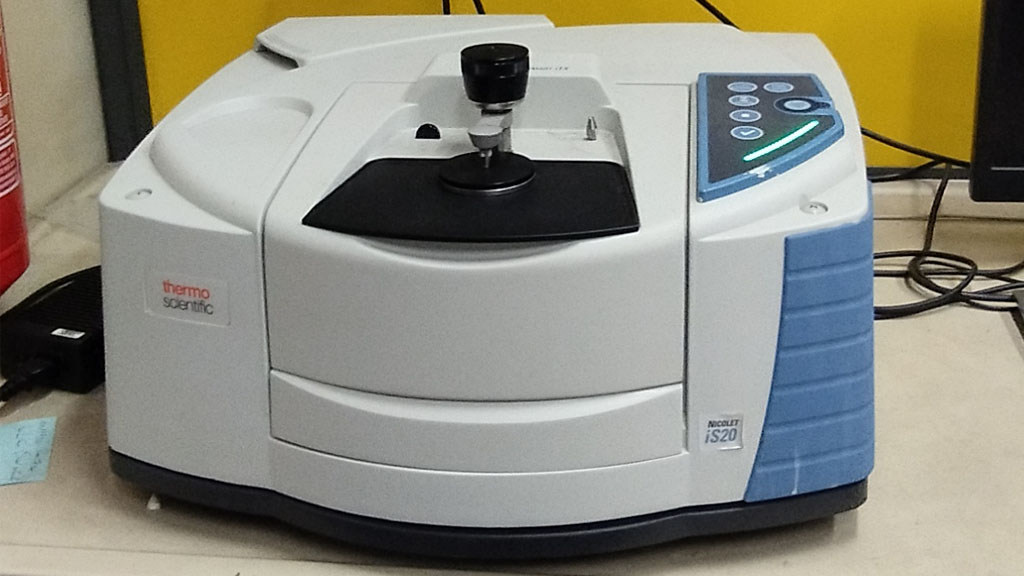
Nicolet iS20 Attenuated Total Reflection InfraredThe Thermo Scientific™ Nicolet™ iS20 FTIR spectrometer features the LightDrive™ Optical Engine, integrating source, laser, interferometer, and detector in a compact, temperature-stabilized, solid-state design.
Its high-performance diode laser, with extended lifetime and precise thermal control, ensures reproducible, accurate spectral acquisitions, while the system delivers a spectral resolution better than 0.25 cm⁻¹ and a signal-to-noise ratio up to 50,000:1. The fully sealed optical bench resists humidity and dust, minimizing maintenance, and integrated performance verification tools enhance reliability.
The ATR accessory enables non-destructive sampling through evanescent wave analysis, offering high surface sensitivity and reproducible results with minimal preparation. Typical applications include polymer and plastic characterization, analytical services, quality control (QA/QC), educational training, gemstone and forensic analysis, and research in organic and inorganic materials.
The instrument excels in identifying functional groups, elucidating molecular structures, evaluating chemical modifications and surface coatings, and monitoring polymer composition, chemical stability, and degradation processes. In sensor and electronics development, ATR measurements verify the functionality of layers and surface chemistry, supporting precise device fabrication.
Key benefits of FTIR and ATR techniques include rapid, non-destructive analysis, high repeatability, and suitability for both routine quality control and advanced research. The Nicolet™ iS20 supports diverse scientific fields, such as materials science and polymer engineering.
Technical description
The FTIR (dimensions 570 x 550 x 250 mm) is endowed with LightDrive Optical Engine components (source, laser, interferometer, and detector) and a solid-state, temperature-controlled diode laser that, thanks to its enhanced long-lifetime and temperature-stabilized design, guarantees accurate and precise data acquisitions.
The Nicolet™ iS20 is equipped with the Thermo Scientific™ LightDrive™ Optical Engine, which ensures excellent optical throughput, long-term stability, and high analytical performance. The system delivers a spectral resolution better than 0.25 cm⁻¹ and a signal-to-noise ratio up to 50,000:1, allowing accurate identification of chemical compounds, trace contaminants, and structural features even at low concentrations. The system includes integrated performance verification tools and a multi‑color LED touch interface that simplifies status monitoring and workflow management.
The ATR accessory operates by measuring the evanescent wave generated when infrared radiation undergoes total internal reflection within a high-refractive-index crystal in contact with the sample. This technique provides high surface sensitivity and reproducible results without destructive preparation methods. Key advantages of ATR include fast analysis, reduced operator handling, high repeatability, and suitability for routine quality control as well as advanced research applications.
Research areas and applications
Typical applications of the Nicolet™ iS20 FTIR spectrometer include comprehensive characterization of polymers and plastics, where the system identifies polymer types, evaluates blend ratios, detects additives such as stabilizers, plasticizers, or flame retardants, and tracks degradation processes that influence material performance and service life.
In education and training, the instrument is used to teach principles of infrared spectroscopy, spectral interpretation, and material identification to students and professionals.
FTIR is also used in gemstone and forensic analysis to identify mineralogical and organic constituents, paint chips, fibers, counterfeit materials, and small-particle evidence.
Organic material characterization with this FTIR involves structural elucidation of organic compounds, including functional group assignment by detecting characteristic vibrational bands, which aids in confirming molecular structures and chemical compositions.
In sensor development, the system verifies the chemical integrity of substrates and active layers, ensuring correct surface chemistry and functional performance.
These application areas span research, industrial quality control, forensic evidence analysis, and advanced materials studies. Finally, the implementation of the ATR setup enables minimal sample preparation and non-destructive analysis.
Science highlights
- M. Stefanelli, G. Magna, F. Zurlo, F. M. Caso, E. Di Bartolomeo, S. Antonaroli, M. Venanzi, R. Paolesse, C. Di Natale, D. Monti. ACS Appl. Mater. Interfaces (2019). https://doi.org/10.1021/acsami.8b22749
- A. Scalabre, Y. Okazaki, B. Kuppan, T. Buffeteau, F. Caroleo, G. Magna, D. Manoti, R. Paolesse, M. Stefanelli, S. Nlate, E. Pouget, H. Ihara, D. M. Bassani, R. Oda. Chirality (2021). https://doi.org/10.1002/chir.23339
- I. Di Filippo, Z. Anfar, G. Magna, P. Pranee, D. Monti, M. Stefanelli, R. Oda, C. Di Natale, R. Paolesse. Nanoscale Adv. (2024). https://doi.org/10.1039/D4NA00217B
Experimental team

- Gabriele Magna
- University of Rome Tor Vergata