
Gas Chromatography – Ion Mobility Spectrometer
General Information
Technique
Key Instrumentation
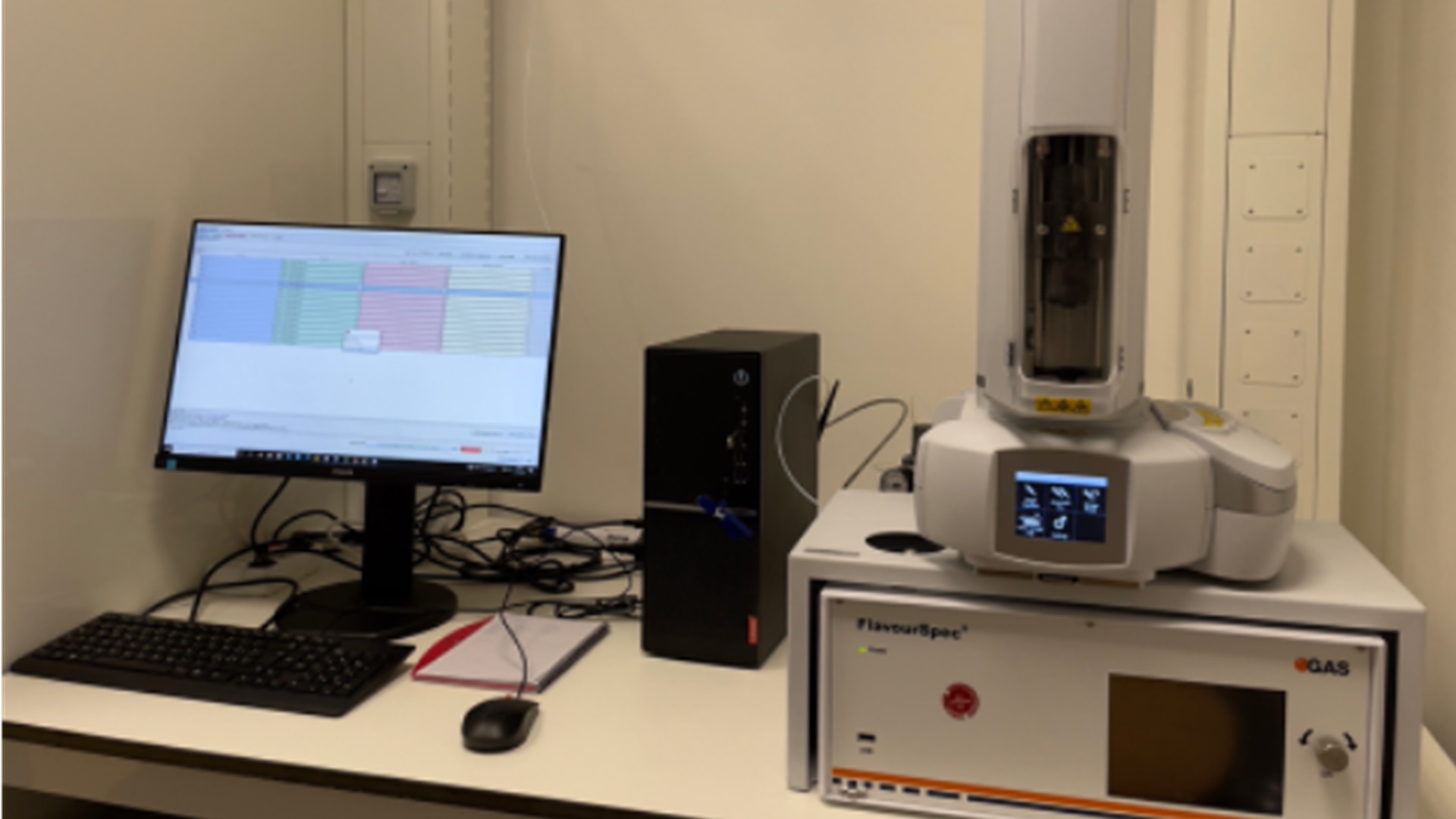
Gas-chromatographyGas chromatograph–ion mobility spectrometer (GC-IMS) (FlavourSpec®, G.A.S. Dortmund, Germany) is a powerful analytical instrument that combines the separation capability of gas chromatography with the high sensitivity and rapid response of ion mobility spectrometry. In GC-IMS, volatile organic compounds are first separated in a chromatographic column according to their physicochemical properties, such as polarity and boiling point. After elution, the compounds are ionized, typically using a soft ionization source that minimizes fragmentation, and introduced into the ion mobility spectrometer. Within the IMS drift tube, ions migrate under an electric field through a neutral drift gas, where they are separated based on their size, shape, and charge. Each compound generates a characteristic drift time, producing a two-dimensional spectrum when combined with the GC retention time. This dual separation significantly enhances selectivity and allows complex mixtures to be analyzed without extensive sample preparation. GC-IMS provides high sensitivity, often reaching parts-per-billion detection limits, together with short analysis times. Moreover, the technique is known for its robustness, low operational costs, and ability to generate reproducible chemical fingerprints suitable for chemometric analysis, making it an attractive tool for routine screening and biomarker research in several application fields, including food, environmental and medical. The instrument is complemented by an autosampler HT2000H (HTA, Brescia, Italy), enabling the automatic analysis, which can accommodate 42 samples and ensures sample temperature control during the sample conditioning.
Technical description
The Gas Chromatography–Ion Mobility Spectrometer (FlavourSpec®, G.A.S. Dortmund, Germany) combine advantages of a Gas Chromatograph (GC) in terms of selectivity and the outstanding sensitivity of an Ion Mobility Spectrometer (IMS), enabling the reliable analysis of volatiles in the headspace of liquids and solid samples without any sample pre-treatment.The FlavourSpec®is particularly suitable for general untargeted analysis.The GC-IMS setup enables a twofold separation of analyte mixtures and the detection by the IMS electrometer.The instrument employs a stable and soft ionization source, ensuring minimal molecular fragmentation and consistent signal generation. The resulting two-dimensional spectra offer high peak capacity and excellent compound discrimination.FlavourSpec® is also supported by dedicated software for real-time visualization, spectral alignment and fingerprint-based comparison of samples. The GC is equipped with a 30 m×0.53 mm I.D.×1 μm MXT-5 column (Restek Corporation, Bellefonte, Pennsylvania), phase equivalent to 5% Phenyl-95% methylpolysiloxane. The FlavourSpec® uses ultra-pure nitrogen (purity>99.9995%) as the carrier gas for the analyses, supplied via an NG SIRIO 1500 nitrogen generator (LNI Swissgas, Milan, Italy).The instrument is complemented by a headspace autosampler HT2000H (HTA, Brescia, Italy), allowing for automatic analyses of up to 42 samples
Research areas and applications
GC-IMS technology is applied across a wide range of scientific, industrial, and clinical fields due to its high sensitivity, rapid analysis capability, and robustness. In food and beverage science, it is widely used for aroma profiling, product authentication, shelf-life assessment, quality control, and detection of adulteration or spoilage processes through volatile fingerprinting. In environmental monitoring, GC-IMS enables screening and identification of airborne pollutants, industrial emissions, and hazardous volatile organic compounds at trace concentration levels. In biomedical and clinical research, G C-IMS has gained growing relevance for non-invasive and minimally invasive diagnostics, including breath analysis, body fluid profiling, and biomarker discovery related to metabolic disorders and disease diagnosis. Additional application areas include pharmaceutical quality assurance, monitoring of fermentation and bioprocesses, microbial identification based on characteristic VOC patterns, forensic investigations, and security screening for explosives or toxic substances.The capability of GC-IMS to generate comprehensive chemical fingerprints further supports advanced chemometric modelling, machine learning classification, and real-time process control, making it a versatile analytical tool for both targeted compound identification and non-targeted screening approaches
Science highlights
- Gasparri, R., Capuano, R., Guaglio, A., Caminiti, V., Canini, F., Catini, A., Sedda, G., Paolesse, R., Di Natale, C., Spaggiari, L. J. Breath Res. 16, (2022). https://doi.org/10.1088/1752-7163/ac88ec.
- Christmann, J., Rohn, S., Weller, P. Data Br. 54, 110532 (2024). https://doi.org/10.1016/j.dib.2024.110532.
- Tata, A., Massaro, A., Damiani, T., Piro, R., Dall, C., Suman, M. Food Control. 133, 108645 (2022). https://doi.org/10.1016/j.foodcont.2021.108645.
Experimental team

- Rosamaria Capuano
- NAST Centre - University of Rome Tor Vergata
- Researcher