
Mass Spectrometer 1
General Information
Technique
Key Instrumentation
Rapiflex TissueTyper MALDI-TOF/TOF MS SystemThe rapifleX MALDI Tissuetyper (Bruker Daltonics) is a high-performance MALDI-TOF/TOF mass spectrometer specifically designed for high-speed, high-resolution molecular imaging of biological tissues. The system enables spatially resolved analysis of peptides, proteins, lipids, and metabolites directly from tissue sections, supporting discovery-driven and translational research on complex and clinically relevant samples.
Within our facility, the platform is routinely applied to MALDI Imaging workflows aimed at generating detailed molecular maps, enabling the investigation of tissue heterogeneity and the correlation of molecular information with histological features. These capabilities are particularly relevant for biomarker discovery, disease characterization, and drug distribution studies.
The instrument provides high sensitivity and molecular coverage, enabling the detection of low-abundance species and supporting comprehensive profiling across heterogeneous samples. It supports studies on fresh-frozen and FFPE tissues in translational and pathology-oriented settings. Its high acquisition speed allows the analysis of large tissue areas while maintaining spatial resolution at the cellular or near-cellular level.
The rapifleX operates in close integration with LC-MS/MS proteomics workflows, enabling combined spatial and molecular characterization within multi-omics strategies.
The platform is embedded in an integrated proteomics infrastructure and is supported by dedicated expertise providing end-to-end support, from experimental design and sample preparation to data acquisition, processing, and biological interpretation for academic and industrial users.
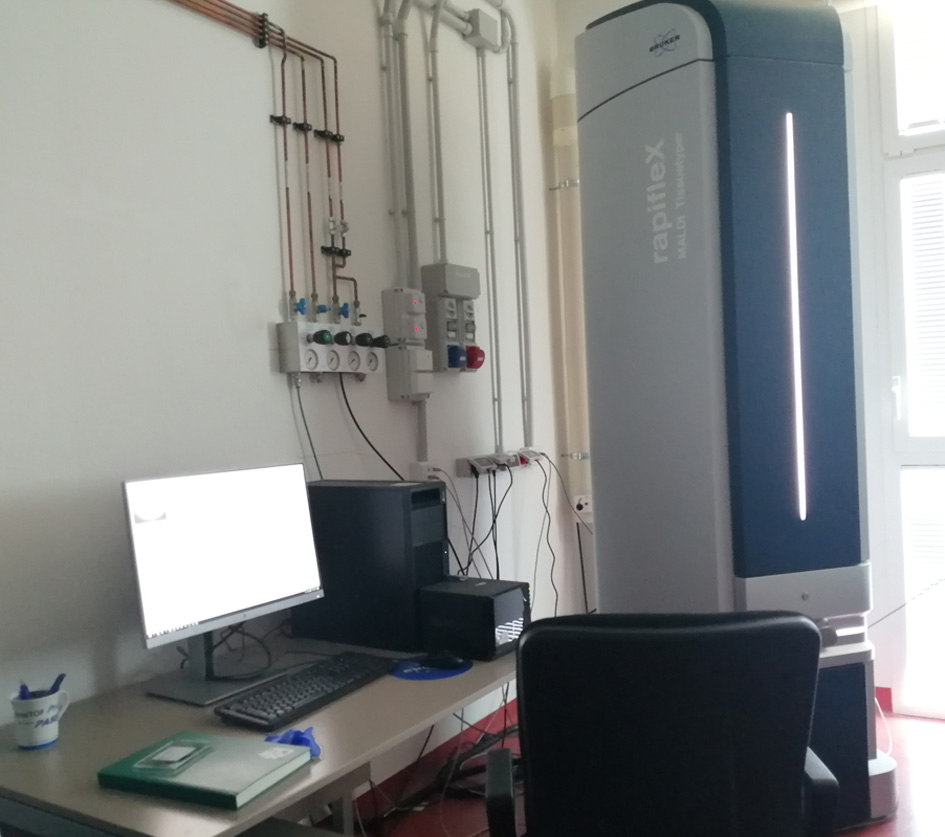
Technical description
The rapifleX MALDI Tissuetyper is optimized for high-throughput MALDI Imaging and combines high acquisition speed, spatial resolution, and analytical sensitivity for the investigation of complex biological samples.
The system is equipped with Smartbeam 3D laser technology, enabling high repetition rates (up to 10 kHz) and fast acquisition suitable for large-scale imaging experiments and high-throughput studies.
Key technical features include:
– spatial resolution down to 10–20 µm, enabling near single-cell level analysis
– high acquisition speed (up to ~40 pixels/sec) for large tissue areas
– MS and MS/MS (TOF/TOF) capabilities for molecular identification
– high sensitivity for low-abundance biomolecules (peptides, lipids, metabolites)
– robust performance across heterogeneous tissue samples
The platform is supported by advanced software tools for data acquisition, visualization, and interpretation, enabling integration of molecular data with histological information and facilitating large-scale imaging datasets and comparative analyses across multiple samples.
The system is fully integrated within the facility’s multi-omics workflows, allowing correlation with LC-MS/MS proteomics data and supporting comprehensive spatial and molecular analyses in both research and translational applications, including biomarker-oriented studies and clinical applications.Research areas and applications
The rapifleX platform supports a wide range of applications in spatial biology, with a strong focus on translational and clinically oriented research.
Within our facility, the instrument is routinely applied to MALDI Imaging workflows for the investigation of molecular distributions in complex biological systems and clinically relevant samples.
Key research areas and applications include:
– spatial proteomics, lipidomics, and metabolomics
– tissue-based biomarker discovery and validation
– characterization of disease-associated molecular signatures
– drug distribution and pharmacological studies in tissue context
– correlation of molecular profiles with histological features
– investigation of spatial heterogeneity in complex tissues
The integration with histological information enables direct correlation between molecular data and tissue architecture, supporting applications in oncology, pathology, and disease-related research.
A major strength of the platform is its integration with LC-MS/MS proteomics workflows, enabling multi-omics approaches that combine spatial molecular information with deep proteome characterization.
These capabilities support applications in systems biology, translational research, and precision medicine, bridging discovery science and clinical investigation, and enabling comprehensive analysis of complex biological systems in biomedical research.Science highlights
The platform supports advanced spatial multi-omics approaches, enabling the integration of MALDI Imaging with deep proteomics workflows for the characterization of complex biological systems and clinically relevant samples.
Representative applications include:
– Bindi et al. J. Proteome Res. 24, 871–880 (2025). doi: 10.1021/acs.jproteome.4c00914
– Bindi et al. Amyloid 32, 335–343 (2025). doi: 10.1080/13506129.2025.2530532
– Denti et al. J. Proteome Res. 21, 2798–2809 (2022). doi: 10.1021/acs.jproteome.2c00417
Experimental team
- Fulvio Magni
- University of Milano Bicocca
- Professor

- Clizia Chinello
- University of Milano Bicocca
- Technical Staff