
Mass Spectrometer 2
General Information
Technique
Key Instrumentation
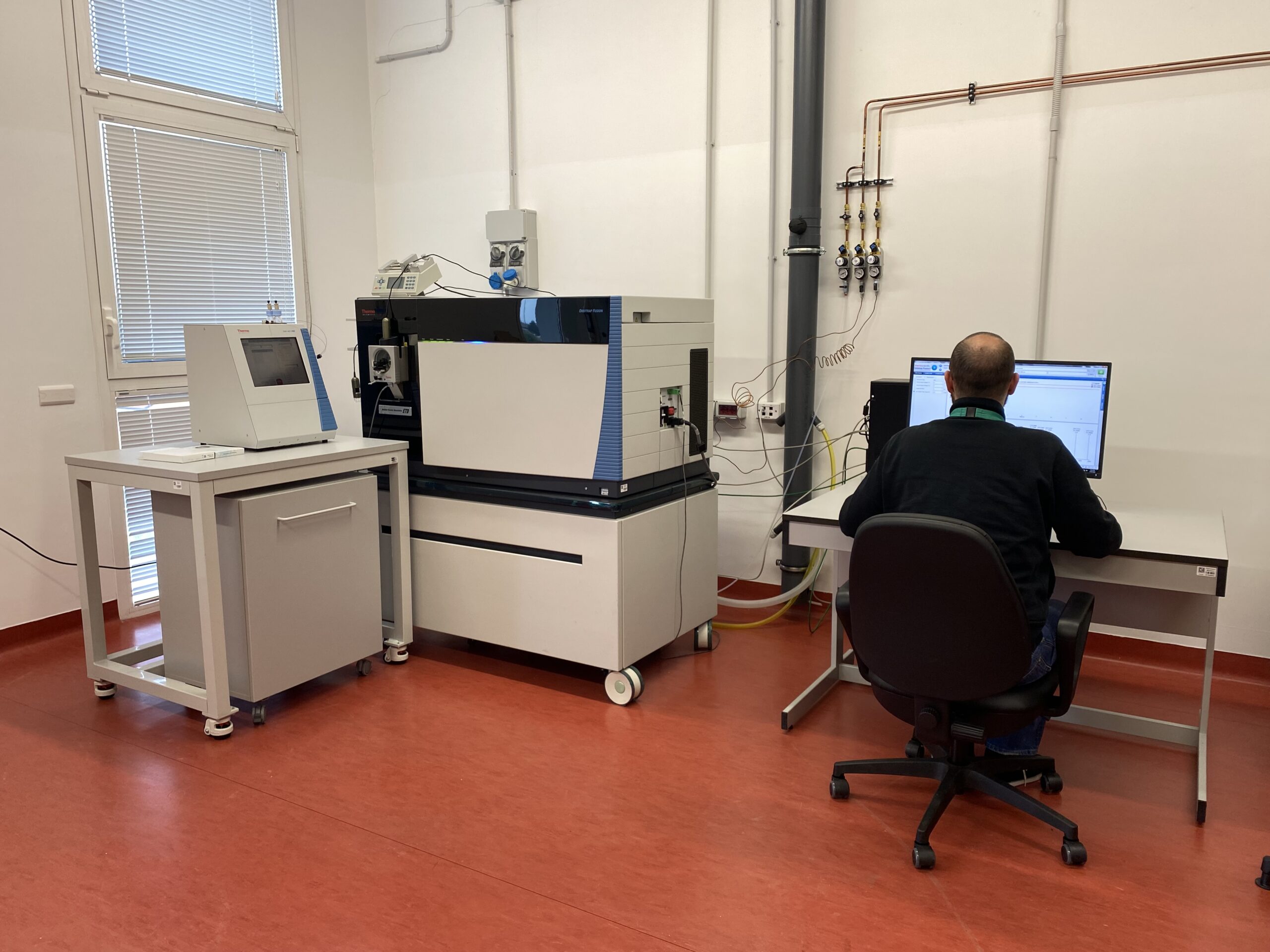
The Orbitrap Fusion Tribrid mass spectrometer at the University of Milano‑Bicocca is a high‑performance analytical platform designed for the in‑depth characterization of molecules and supramolecular complexes across proteomics, structural proteomics, metabolomics, and other omics sciences. Its tribrid architecture—combining a quadrupole, a linear ion trap, and an Orbitrap analyzer—enables exceptional analytical flexibility and supports ultra‑high‑resolution measurements, accurate mass detection, and advanced fragmentation strategies for comprehensive molecular elucidation.
The system offers multiple, fully integrated fragmentation modes, including CID, HCD, and ETD, as well as their combined or sequential use, allowing precise interrogation of complex biomolecules, post‑translational modifications, and labile structural features. This versatility makes the instrument suitable for both discovery‑driven workflows and targeted quantitative analyses.
Coupled with a nano‑flow UHPLC EASY‑nLC 1000, the platform provides automated, high‑performance LC–MS for the separation and identification of components in highly complex biological matrices. The chromatographic system ensures excellent retention‑time stability, low‑flow sensitivity, and optimal compatibility with nanospray ionization, enabling deep proteome coverage and robust analysis of low‑abundance species.
Technical description
The Orbitrap Fusion Tribrid mass spectrometer at the University of Milano‑Bicocca enables high‑performance analysis of molecules and supramolecular complexes across the 50–6,000 m/z range. Its tribrid architecture integrates a quadrupole, a linear ion trap, and an Orbitrap analyzer, delivering ultra‑high resolution (up to R = 450,000), fast scan rates (MSⁿ up to 20 Hz), 5,000 dynamic range, and excellent sensitivity, detecting as little as 100 fg of reserpine.
The system offers extensive flexibility in fragmentation strategies, supporting CID, HCD, ETD, and combined or sequential dissociation modes. Fragmentation can be performed in either the quadrupole or the linear ion trap, with detection in the ion trap or Orbitrap, enabling tailored acquisition workflows for structurally complex analytes. These capabilities support bottom‑up, top‑down, and middle‑down proteomics, as well as high‑depth characterization of small molecules, peptides, intact proteins, post‑translational modifications, protein–ligand complexes, and synthetic or biological polymers. Quantitative shotgun proteomics can be performed using stable‑isotope labeling or label‑free approaches.
The instrument is equipped with both standard and nano‑ESI sources and can be coupled to a nano‑flow UHPLC EASY‑nLC 1000, enabling automated, high‑performance LC–MS analysis of complex biological matrices. Data processing and interpretation are carried out using Proteome Discoverer 2.2, supportiResearch areas and applications
Clinics, Integrated Biology
Science highlights
Experimental team

- Università di Milano-Bicocca
- Professor
Rita Grandori

- Università di Milano-Bicocca
- Post-Doc