Micro-FTIR & Rapt-IR
General Information
In 2019, the European Chemical Agency clearly defined microplastics and their sizes: “a material composed of solid polymer-containing particles, to which additives or other substances may have been added, with particle dimensions ranging from 1 nm to 5 mm and with fiber lengths ranging from 3 nm to 15 mm and a length-to-diameter ratio of >3. ECHA has also firmly stated that polymer identification during microplastics analysis is fundamental. The identification must be univocal and unambiguous. Plastic additives can interact with polymers in various ways, being added at any stage of plastic product production. Some are embedded in polymers, such as cross-linkers or plasticizers, while others are loosely bound to plastic objects, e.g., finishing agents for textiles or extruding agents. During the breakage, plastic objects can fragment into microplastics and plastic additives. Plastic additives can exert negative and adverse effects on biota. Microplastics, especially those < 100 µm, can be easily mistaken for food particles and enter the trophic web. All those particles can exert adverse effects on biota and humans. Particles Analysis provides an accurate simultaneous quantification (via microscopic counting) and characterization (unequivocal identification) of microplastics and other anthropogenic particles, by also employing various reference libraries. This allows for evaluating the environmental risk assessment and designing future actions of environmental management and recovery. Identification and quantification are performed simultaneously. Thanks to the non-destructive pretreatment methods developed, the minimum size analyzed (LOD) is 5 µm.
Technical description
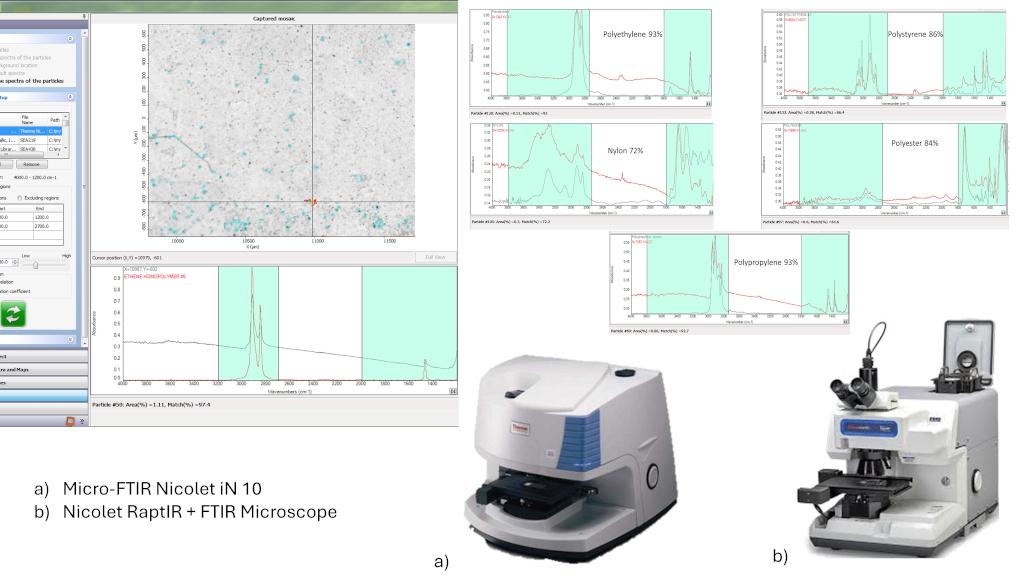
Micro-FTIR Nicolet™ iN™10 Infrared Microscope Thermo Scientific, which couples optic microscopy with IR spectroscopy. Two detectors are present: a DTG (Deuterated Triglycine Sulfate) detector enables room-temperature analysis, and an MCT (Mercury Cadmium Telluride) detector operates at liquid nitrogen temperature. The Infrared resolution is 10 µm. However, it enables analysis of samples down to 5 µm, thanks to developed pretreatments that prevent loss or further denaturation/degradation of polymers and other anthropogenic particles. Samples can be analyzed in transmittance, reflectance, and ATR modes. However, the use of aluminum oxide filters enables analysis in transmittance mode (highest energy), which is particularly useful for microplastic analysis, especially those <100 µm.
Nicolet RaptIR-FTIR Microscope: The Nicolet RaptIR is adapted to interface with a Nicolet iS50 FTIR Spectrometer. It is equipped with an MCT (Mercury Cadmium Telluride ) detector, using liquid nitrogen. Samples can be analyzed in transmittance, reflectance, and ATR modes. It is also equipped with an NIR (near infrared) detector. Visible resolution down to 1 µm, Infrared resolution down to 5 µm. Aluminum oxide filters can be employed to analyze microplastics and other anthropogenic particles in various environmental matrices.
The instruments are equipped with different reference libraries.
Research areas and applications
Particles Analysis allows for the simultaneous identification and quantification of particles, e.g. microplastic. Particles Analysis via Nicolet™ iN™10 and via Nicolet RaptIR-FTIR Microscope can be performed on filters, where microplastics and other anthropogenic litter were collected after the extraction from several environmental matrices: seawater, wasterwater, stormwater, drinking water, wet and dry depositions, atmospheric aerosol, snow, sediments, soil, permafrost, organisms, e.g., mussels, clams, small benthic and zooplanktonic invertebrates, crustaceans, fish.
The analysis can also be performed on large microplastics (from 5 mm down to 1 mm). The analysis can also be performed via ATR-MicroFITR.
Particles analysis via Micro-FTIR allows quantification and simultaneous polymer identification of plastic particles (including bioplastics), and of other anthropogenic particles such as plastic additives, (e.g., cross-linkers, vulcanizers, antioxidants, lubricants, flame retardants, plasticizers, etc), artificial and natural fibers. It can be employed for analysis of microplastics, but also for analysis of microfossils, artistic handiworks, pharmaceuticals, etc. The instruments are equipped with various reference libraries.
Furthermore, the RaptIR is equipped with an NIR detector that can be used to cross-validate polymer identifications in another spectral range.
Science highlights
Corami, F., Rosso, B., Morabito, E., Rensi, V., Gambaro, A., & Barbante, C. Science of the Total Environment, 797, 148937, (2021). https://doi.org/10.1016/j.scitotenv.2021.148937
Corami, F., Rosso, B., Bravo, B. Application note. Thermofisher Scientific. Wisconsin, US. (2025). https://documents.thermofisher.com/TFS-Assets/CAD/Application-Notes/microplastics-and-microlitter-analysis-mcs-an1267-en.pdf
Rosso, B., Gregoris, E., Litti, L., Zorzi, F., Fiorini, M., Bravo, B., … & Corami, F. Environmental Pollution, 326, 121511, (2023). https://doi.org/10.1016/j.envpol.2023.121511