AFM Raman with SNOM
General Information
Unit
CNR-IPCBTechnique
Key Instrumentation
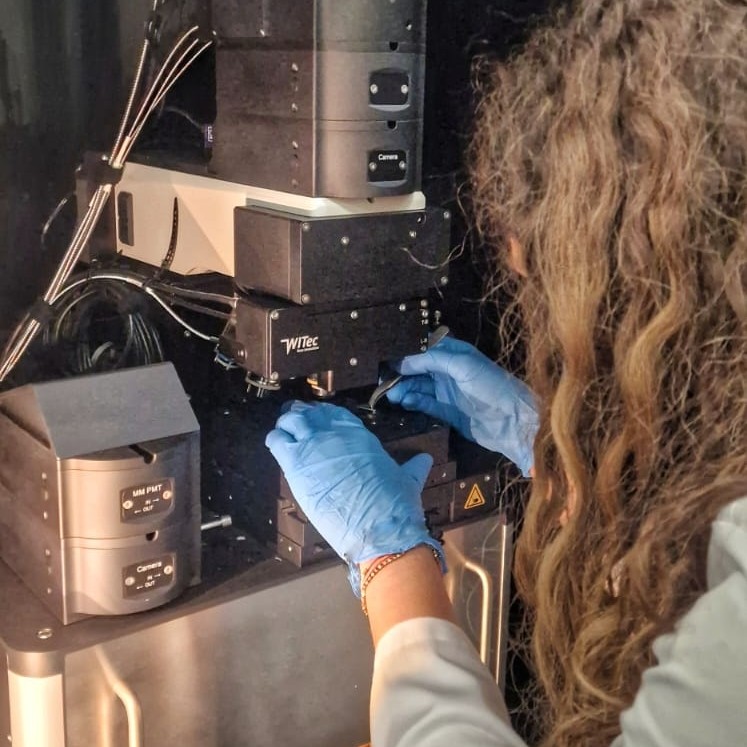
The WITec alpha300 microscope is a versatile and user-friendly platform that integrates Scanning Near-field Optical Microscopy (SNOM), confocal microscopy, and Atomic Force Microscopy (AFM) within a single system. This unique combination enables comprehensive nanoscale characterization by correlating optical, chemical, and topographical information. Users can seamlessly switch between measurement modes through a simple rotation of the objective turret, ensuring flexibility and ease of operation.
The alpha300 series supports multiple beam path geometries, allowing adaptation to a wide range of excitation and detection schemes. Its modular design accommodates both inverted and upright microscope configurations. The inverted setup is particularly suited for transparent samples, such as those commonly encountered in life sciences, while the upright configuration and side-illumination options provide optimal performance for opaque materials.
By integrating complementary techniques into one platform, the system enables efficient workflows and precise co-localization of data acquired from the same sample region. This capability is especially valuable for applications requiring correlated structural, chemical, and optical analysis at the micro- and nanoscale.
As a result, the WITec alpha300 platform delivers optimized performance across a broad spectrum of research fields, including life sciences, pharmaceutics, materials science, carbon-based materials, photovoltaics and semiconductors, nanophotonics, and low-dimensional materials. Its flexibility and advanced capabilities make it a powerful tool for both fundamental research and applied investigations.
Technical description
The WITec alpha300R is a modular correlative microscopy platform combining confocal Raman spectroscopy, atomic force microscopy (AFM), and scanning near-field optical microscopy (SNOM) within a single instrument. The confocal Raman module supports up to three excitation lasers (e.g. 532, 633, 785 nm) coupled via single-mode fibers to ensure diffraction-limited excitation and high spectral sensitivity. Automated wavelength switching and alignment enable flexible multiwavelength measurements, including polarization-dependent studies. The optical microscope features a motorized z-stage with 10 nm step resolution, autofocus for uneven surfaces, and a 6-position turret supporting multiple contrast techniques. Raman imaging allows chemical mapping with sub-micrometer resolution, while high-throughput spectrometers enable fast acquisition of large datasets. The system is fully extendable to AFM and SNOM. AFM provides nanoscale topography and nanomechanical characterization with automated tip approach and multiple operation modes. SNOM enables optical imaging beyond the diffraction limit, achieving lateral resolution down to tens of nanometers. Instrument control is managed via FPGA-based electronics and integrated software, enabling simultaneous multimodal measurements and precise spatial correlation of Raman, AFM, and SNOM data for advanced micro- and nanoscale analysis.
Research areas and applications
The WITec alpha300 platform enables the exploration of emerging research areas that require correlated chemical, structural and optical information at the micro- and nanoscale. Its multimodal capabilities open new opportunities in nanophotonics, where near-field optical mapping combined with Raman spectroscopy provides detailed insight into light–matter interactions beyond the diffraction limit. In low-dimensional and quantum materials, the system supports investigation of strain distribution, defects, and electronic properties with high spatial precision. The integration of AFM and Raman further advances research in energy materials, including photovoltaics and batteries, by enabling simultaneous analysis of morphology and composition. In life sciences and pharmaceutics, the inverted configuration allows label-free imaging of cells, tissues, and drug delivery systems under physiologically relevant conditions. Additionally, the platform enables advanced investigation of polymers, nanocomposites and carbon-based materials by providing correlated nanoscale insights into chemical composition, morphology, and local optical properties. Its capability allows real-time monitoring of dynamic processes, such as, chemical reactions, degradation mechanisms and interfacial phenomena, under realistic environmental conditions, enhancing the understanding of material behavior and performance.
Science highlights