SAXS GISAXS
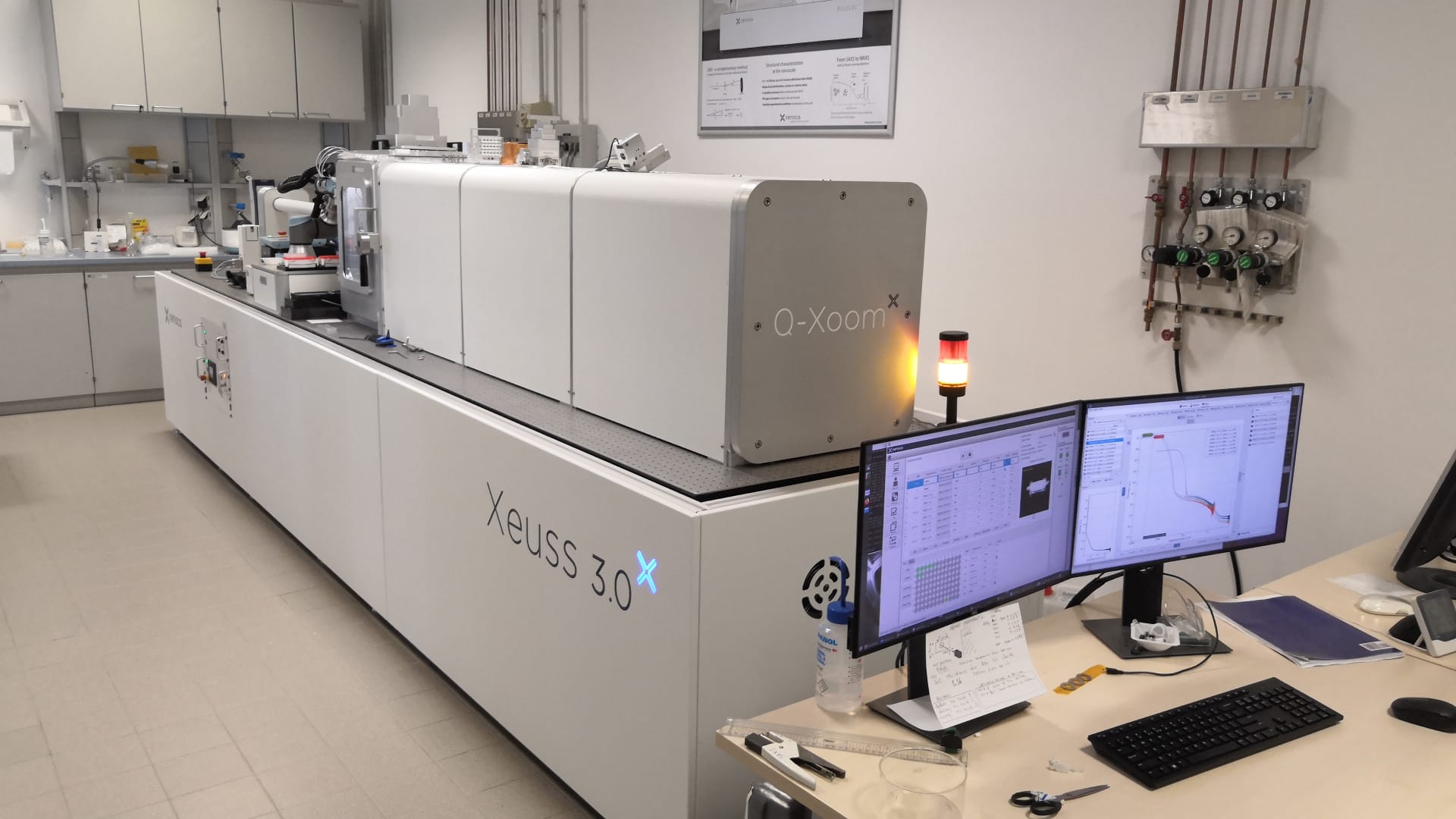
The SAXS/GISAXS facility at the CSGI – University of Florence unit is based on a Xenocs XEUSS 3.0 system designed for high‑precision structural characterization of materials at the nanoscale.
The instrument operates in SAXS, USAXS, and GISAXS modes, enabling the investigation of bulk samples, thin films, nanostructured surfaces, and soft‑matter systems across a wide q‑range. Its versatile configuration allows measurements on powders, pastes, gels, liquids, and films through a comprehensive set of sample holders that support both standard and customized environments. The system integrates precise temperature‑control modules for studies under variable thermal conditions, facilitating the analysis of phase transitions, self‑assembly processes, and thermally activated structural rearrangements. A robotic unit automates sample loading and preparation, ensuring high throughput, reproducibility, and efficient workflow management for large experimental series. The collimation and beam‑conditioning optics provide a highly focused and stable X‑ray beam, enabling measurements with excellent signal‑to‑noise ratio, while the GISAXS geometry allows detailed investigation of surface‑supported nanostructures, thin‑film morphology, and in‑plane ordering. The system’s advanced detection capabilities support rapid data acquisition and time‑resolved experiments, making it suitable for kinetic studies and in‑situ monitoring of structural evolution. Overall, the XEUSS 3.0 platform offers a powerful and flexible solution for researchers and industrial users requiring quantitative nanoscale characterization across diverse material classes.
Technical description
The SAXS/GISAXS facility at the CSGI – University of Florence unit is based on a Xenocs XEUSS 3.0 system designed for high‑precision nanoscale structural characterization. The instrument operates in SAXS, USAXS, and GISAXS modes, enabling the analysis of bulk materials, soft‑matter systems, thin films, and nanostructured surfaces across an extended scattering‑vector range from 0.0002 to 3.1 Å⁻¹. Its versatile configuration includes dedicated sample containers for powders, pastes, gels, liquids, and thin films, supporting both standard and customized measurement environments. Temperature‑controlled stages allow experiments under variable thermal conditions, facilitating studies of phase transitions, self‑assembly, and thermally driven structural evolution. Automated sample preparation for liquid specimens is performed through an integrated Universal Robot, ensuring high throughput, reproducibility, and efficient workflow management. The system’s advanced collimation and beam‑conditioning optics deliver a stable, well‑defined X‑ray beam suitable for high‑sensitivity measurements, while the GISAXS geometry enables detailed investigation of surface‑supported nanostructures, film morphology, and in‑plane ordering. Fast, high‑resolution detectors support time‑resolved experiments, making the platform suitable for kinetic studies and in‑situ monitoring. Overall, the XEUSS 3.0 system provides a powerful and flexible solution for researchers and industrial users.
Research areas and applications
The system allows for studying (fr instance):
- Particle size distribution ranging from few nanometers to more than 350 nm in diameter
- Crystallization rates and lamellar structure of semicrystalline polymers
- Size and shape analysis of surfactants or proteins in solutions
- Organization and orientation of nanomaterials at atomic or nanoscale, in bulk phases or at surfaces
- Phase segregation studies of alloys
- In situ studies of nanostructure transitions
Science highlights
- Hybrid fibroin-nanocellulose composites for the consolidation of aged and historical silk, Cianci et al. https://doi.org/10.1016/j.colsurfa.2021.127944
- 2-Butanol Aqueous Solutions: A Combined Molecular Dynamics and Small/Wide-Angle X-ray Scattering Study, Macchiagodena et al. https://doi.org/10.1021/acs.jpca.2c05708
- Effect of Composition and Freeze-Thaw on the Network Structure, Porosity and Mechanical Properties of Polyvinyl-Alcohol/Chitosan Hydrogels, Soto-Bustamante et al. https://doi.org/10.3390/gels9050396