SEM FEI
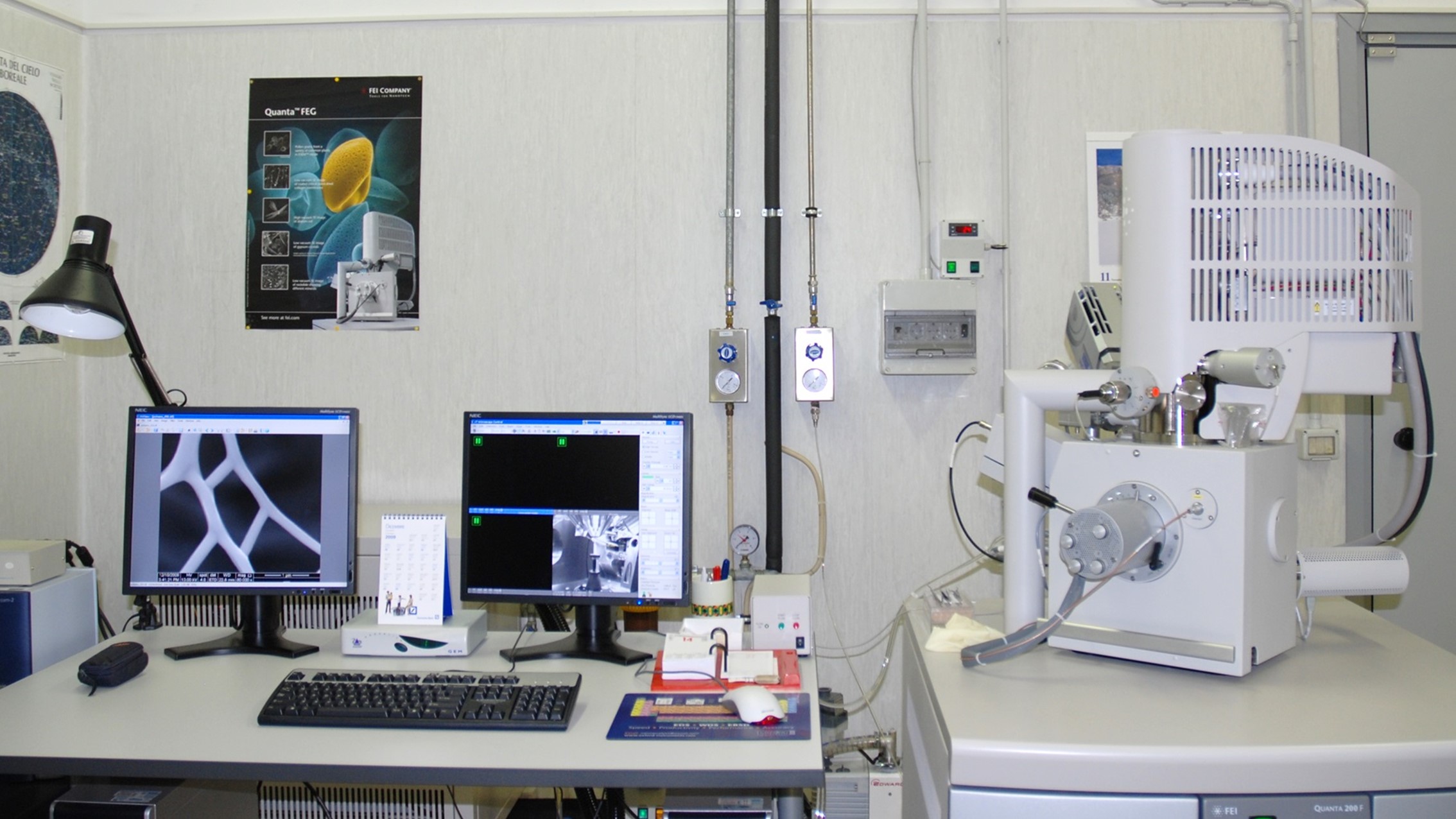
The SEM FEI system at the CNR‑IPCB unit is a highly versatile platform designed for the morphological and microstructural characterization of inorganic, organic, polymeric, and biological materials under a wide range of environmental conditions. Its configuration supports high‑vacuum, low‑vacuum, and extended‑low‑vacuum (ESEM) operation, enabling the analysis of both conductive and non‑conductive samples with minimal or no preparation. The microscope is equipped with multiple electron detectors, including secondary‑electron and backscattered‑electron systems, allowing detailed imaging of surface topography, compositional contrast, and microstructural features at high spatial resolution. Additional analytical capabilities include energy‑dispersive X‑ray spectroscopy for elemental identification and mapping, enabling correlation between morphology and chemical composition. The instrument also features an accessory for in‑SEM mechanical testing, allowing real‑time observation of deformation, fracture, and mechanical response under controlled loading conditions. This capability is particularly valuable for studying the behavior of soft materials, thin films, fibers, and micro‑structured systems. The ESEM mode permits imaging of hydrated, beam‑sensitive, or environmentally reactive samples by controlling chamber pressure and water vapor content, making it suitable for biological specimens, gels, and soft‑matter systems. Automated stage control and advanced imaging software support precise navigation, multi‑area acquisition, and high‑throughput workflows. Overall, the SEM FEI system provides a powerful and flexible solution for researchers and industrial users requiring detailed morphological, compositional, and mechanical characterization across diverse material classes.
Technical description
The SEM FEI Quanta 200 at the CNR‑IPCB unit is a versatile field‑emission scanning electron microscope designed for high‑resolution morphological and microstructural analysis of inorganic, organic, polymeric, and biological materials. Its environmental capabilities allow operation in high vacuum, low vacuum, and ESEM modes, enabling the examination of non‑conductive, hydrated, or beam‑sensitive samples with minimal preparation. The system is equipped with a Peltier stage and a Peltier heating stage control kit capable of reaching 1000 °C, supporting in‑situ thermal studies and controlled‑environment experiments. Elemental analysis is performed through an Oxford INCA Energy 250 EDS system featuring an LN₂‑free INCAx‑act silicon drift detector with PentaFET® Precision technology, ensuring high sensitivity and fast spectral acquisition. Multiple detectors enhance imaging versatility, including an Everhardt‑Thornley secondary‑electron detector, a large‑field detector for low‑vacuum imaging, a gaseous SED for ESEM operation, backscattered‑electron detectors for compositional contrast in high‑vacuum mode, and a solid‑state STEM detector for transmitted‑electron imaging of thin specimens. Together, these components enable comprehensive characterization of surface morphology, composition, and microstructure. The platform also supports in‑SEM mechanical testing, allowing real‑time observation of deformation and failure mechanisms.
Research areas and applications
Thanks to its versatility and its accessories, the SEM FEI is very useful for the characterization in high vacuum, low vacuum and extended low vacuum (ESEM) conditions of inorganic, organic and biological materials through morphological analysis using different detectors and elemental analysis and mapping. The accessory for in-SEM mechanical analysis of samples is also available.
Science highlights